
anthropomorphism — noun
an·thro·po·mor·phism [ˌan(t)-thrə-pə-ˈmȯr-ˌfi-zəm]
The attribution of human traits or characteristics to non-human entities. Also, something I do all the time.
I decided to lead with the preceding definition because it applies to much of what follows. I have no regrets or apologies.

One of the widely overlooked and sadly under-appreciated benefits of retirement is the amount of time one can devote to the observation of lizards.
A Texas spiny lizard has taken up residence in our back yard. We see it almost every day, generally resting on the edge of the deck or porch, seemingly on point, watching for threats to our mostly tranquil lives. Alert Gazette readers will remember a recent video of her [1] chowing down on a caterpillar.
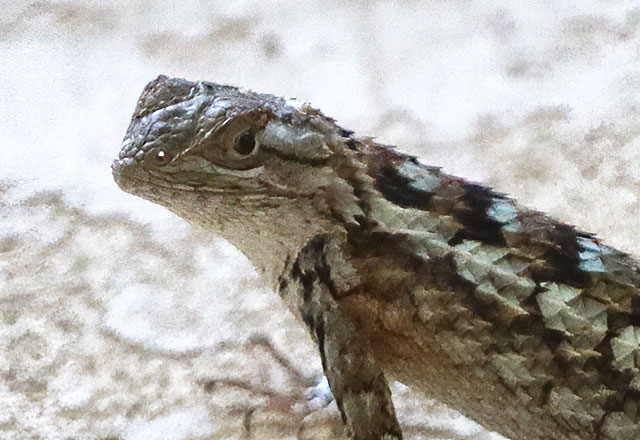
I recently watched as she stalked, captured, and devoured a mud dauber [2] (a black wasp in the genus Sceliphron) resting on the porch. To be honest, the stalking and capturing steps were pretty undramatic, as the wasp had not moved in a couple of hours; it appeared to be in the process of dying — adult mud daubers have a lifespan of only about a month — but I suppose the lizard had no way of knowing that.
I watched through the glass of our back door as prey and predator remained motionless for several minutes, long enough that I stopped videoing the inert scene. And, of course, just as I did, the lizard pounced, covering the three feet of distance between them in an eye blink. I did have the presence of mind to record the following video of the meal itself (please forgive the shaky camera work; I have a really hard time holding a subject in view when my iPhone is set to 5x magnification).
I was amused by the up-and-down actions of the lizard after swallowing the wasp, as if it was wondering, “what the heck did I just eat?”
Things got even more interesting. The lizard moved across the porch, stopping every few feet to assess its surroundings. After it had moved about twenty feet, another wasp began flying in the lizard’s vicinity. The lizard froze, but it moved its head to track the motion of the wasp whenever it got near. Then, unexpectedly, the lizard actually leaped as it attempted to catch the wasp in midair. The attempt was unsuccessful — I’m don’t think the lizard’s back legs ever left the concrete — but I was gobsmacked by the attempt, and I shall forever hereafter have a vivid mental image whenever I hear the phrase leapin’ lizards [3].
Now that we know the lizard won’t hesitate to dine on wasps, we’re even more happy to have it on lookout duty. Unfortunately, as far as we know, it doesn’t climb walls, even though it’s an expert tree climber (and I suspect it spends its nights high up in the pecan tree growing out of our deck, protected from its own predators; its scale pattern and color give it perfect camouflage when on the bark).
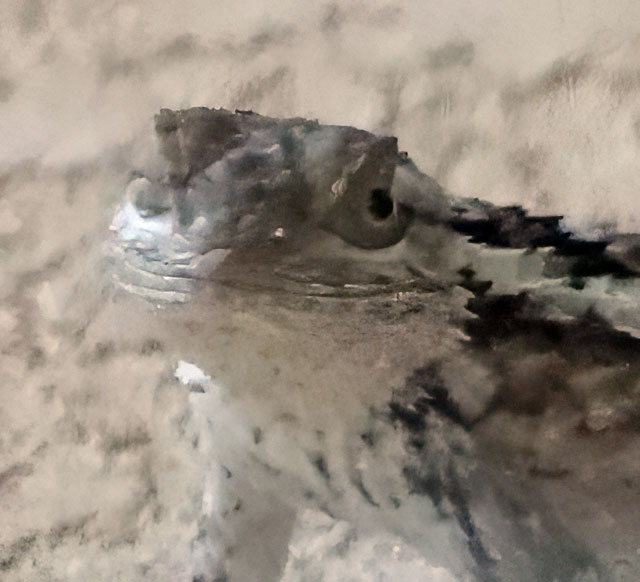
Here’s one final anthropomorphic observation: I think the lizard recognizes me and knows that I pose no threat. Yesterday, I was able to get within a couple of feet to take the following photo and she never blinked an eye (and, yes, Texas spiny lizards have eyelids, like most lizards, with the notable exception of most geckos). Now, I may have violated that trust when I intentionally got too close in order to see if she would escape up a tree (which she in fact did). I hope she doesn’t hold it against me. Perhaps I should look for another ailing wasp to give her as a peace offering.
Footnotes
[1] I’ve assumed all along that our lizard is a male, probably due to some unconcious anthropomorphic bias, but after doing some research and then spending twenty minutes arguing the issue with ChatGPT (seriously…I questioned its original premise and it changed its “mind.” AI: 10 million; Humans: ~1), I believe we’re dealing with a formidable female. The distinction is based on (1) the sharpness of the pattern on the back, (2) the absence of blue dots along the belly, and (3) the size — female TSLs are larger than males. Unfortunately, the absolute distinction requires an inspection of the post-anal scales, and our lizard isn’t about to cooperate with that level of invasion of its personal space. As George Banks famously exclaimed in Father of the Bride II — Excuse me…do I know you!? (Ignore the fact that it’s a prostate exam; work with me here, OK?):
[Return]
[2] Mud daubers are the bane of many homeowners in our neck of the woods. The females build nests on the walls of structures, using mud gathered a tiny ball at a time from the banks of lakes, creeks, and ponds, or even from damp dirt in flowerpots. Those nests are almost impossible to remove without staining or even damaging the walls on which they’re built. But I’ll give them grudging respect for their construction skills that result in veritable houses of horror for spiders. Once the nest is finished — it’s actually a tube, or multiple tubes, depending on the species — the wasp seeks out and paralyzes spiders and packs the tubes with them, sometimes as many as twenty unfortunate arachnids. She then lays an egg in the tube and seals it up with more mud. When the egg hatches, the wasp larva has a built-in source of food in the form of those drugged spiders, and dines on them until its ready for the next step in its life cycle.
By the way, these wasps are not aggressive; they will sting but only defensively, and they don’t defend their nests, unlike yellowjackets, a species with a notoriously bad attitude.
Here’s a detailed explanation of the mud dauber’s unusual life cycle, focused on a slightly different species of mud dauber, but the facts are the same. [Return]
[3] The phrase leapin’ lizards was first employed as the titular character’s exclamation of surprise in the Depression-era comic strip, Little Orphan Annie. You probably knew that — or at least are not surprised by it — but did you know that the comic strip’s title was taken from an 1885 poem entltled Little Orphant Annie, and if you think the mud dauber’s Tube O’Horror is bad, you should read that poem while alone on Halloween night by the light of a single candle after watching an uncensored showing of The Exorcist. (The full text is found via the preceding link to the poem’s Wikipedia page. Actually, read the whole Wikipedia page; the history of the poem is quite interesting, although completely irrelevant to the subject of lizards, leaping or otherwise.) [Return]
Discover more from The Fire Ant Gazette
Subscribe to get the latest posts sent to your email.