
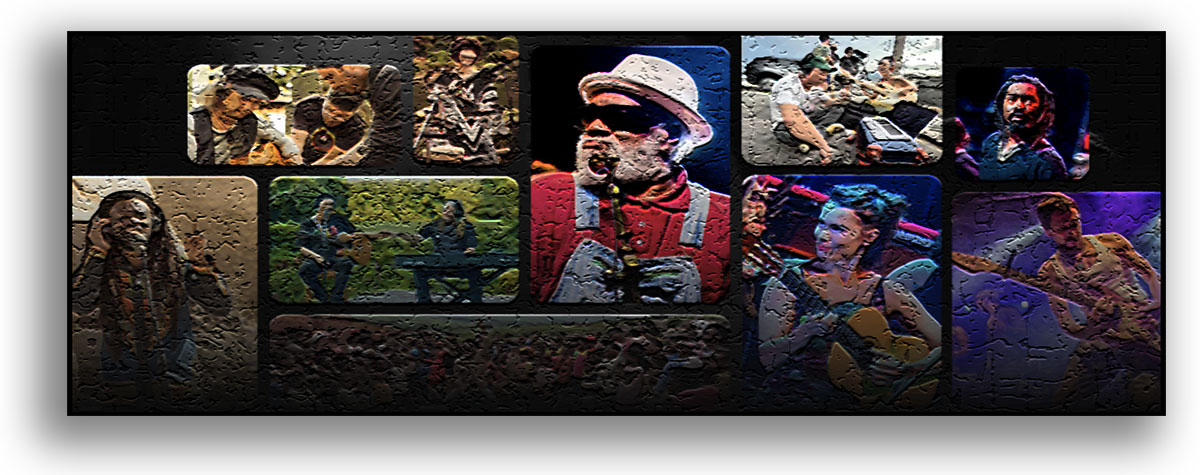
Alert Gazette readers may recall that I mentioned in passing Playing For Change (PFC) back in January. But, in case you missed it, here’s a brief introduction.
It was a bit of a challenge to decide how to describe the organization behind PFC. According to its website, it began as a collaboration between two people who set out with mobile recording equipment to capture live performances by street musicians across America. Their efforts led to an award-winning documentary in 2005 entitled A Cinematic Discovery of Street Music. [You can listen to the music included in this documentary; the video is available for purchase on DVD.]
The success of that endeavor apparently opened doors for new opportunities. Today, PFC is a Certified B Corporation. A Certified B Corporation is a for-profit business verified by the non-profit organization B Lab to meet high standards of social and environmental performance, public transparency, and legal accountability. That entity now travels the world to capture outdoor performances by a huge variety of musicians and combine those performances to create hundreds of videos that are, frankly, stunning in terms of both sight and sound. More about that in a moment. But let’s pause for a musical interlude…
In addition to the for-profit B Corp, in 2007 PFC formed the Playing For Change Foundation to create programs in underserved countries around the world. According to the Foundation, it has created 37 programs in 26 countries on five continents. The programs begin with music but extend much further, into diverse areas such as providing emergency supplies and supporting environmental, educational or development projects. Here’s a video overview of the Foundation’s work.
Since its inception, PFC has produced more than 400 videos, including outdoor musical performances, documentaries, and live concert videos of the Playing For Change Band, which travels the world in support of PFC’s goals. Here’s the band’s performance of Stand By Me during its 2014 concert in Curitiba, Brazil. (Besides enjoying the music, you can also pick up a bit of Brazilian Portuguese by watching the captions…fica conmigo!)
I alluded to my admiration of the technical aspects of combining performances by musicians around the world into a unified performance, and I’m still not sure where the magic comes from. So I asked Google Gemini to explain how it’s done — using this prompt: How does Playing For Change accomplish the seamless music involving people from around the world? — and here’s the answer it provided [edited by me for length and content…take that, A.I.!]
Bringing the Studio to the People: The PFC crew travels across the globe with portable recording gear and cameras to capture street performers and world-class musicians live in their natural environments.
Establishing the Foundation (Layering Process): The production crew starts by recording one musician playing a raw rhythm or acoustic performance of a song. Once the initial track and tempo are locked in, the crew travels to the next country. They place headphones on the next musician, allowing them to listen directly to what the previous artists recorded. That musician then plays along to the track live in real time, adding their own cultural flavor, instrument, or vocal harmony.
Natural Acoustics and Dry Audio: (This is the good stuff!) Because there are no walls or enclosed ceilings to bounce sound waves back into the microphones, the recorded tracks are “super dry,” meaning they lack room reflections or echo. This pristine audio purity allows studio engineers to cleanly blend and process dozens of different instruments later without any overlapping acoustic artifacts.
Detailed “Deconstruction” and Mixing: Back in the editing room, producers “deconstruct” and reconstruct the audio. They meticulously align the timelines, balance the volume levels, and weave the different instruments into a unified arrangement.
No Overnight Sensations: (My summary) These efforts sometimes span years from the initial recording to the final product.
That’s the cut-and-dried version; here’s a softer explanation of the philosophy and a bit of technique behind the process:
The final result is excellent music and a wonderful demonstration of how different cultures come together to create something that’s much greater than the sum of its parts. I’m going to close by embedding a handful of my favorite selections; I hope you enjoy them as well.

If you’re a fan of Santana (and, really, who isn’t?), this arrangement of Tito Puente Ernest Anthony Puente Jr. (aka Tito; 1923-2000) was an American musician, songwriter, bandleader, timbalero, vibraphonist and record producer. He composed dance-oriented mambo and Latin jazz music. [Click for more via Wikipedia] ‘s Oye Como Va (translation: Hey, how’s it going?) featuring Carlos on guitar and his wife, Cindy, on drums, is a perfect showcase for musicians from Colombia, Panama, Uruguay, the Congo, Brazil, Haiti, the Kingdom of Bahrain, and the USA.
Sticking with the Latin music theme — a personal favorite — here’s PFC’s arrangement of Guantanamera, a song popularized in America in the mid-1960s by The Sandpipers, but which was a popular Cuban folk song (based on the poetry of José Martí) almost forty years earlier. It remains a symbol of Cuban patriotism, and this version features Cuban musicians from around the world, including Havana, Santiago, Barcelona, and Tokyo. Jackson Browne, of Eagles fame, helped with the recording and production.
This arrangement also includes extended lyrics taken from Martí’s original poem; most popular versions omit them. This thread on Reddit provides the most complete lyrics I was able to locate; they’re in Spanish but you can paste them into your favorite translation app if you want to see them in English (the Spanish is prettier). The opening line contains the phrase, guajira guantanamera, referring to a peasant girl or woman from the Guantánamo region of Cuba.
I debated at length with myself — I eventually lost the argument — about which video would provide the best conclusion to this post. The contenders were strong (you can follow the links if you want to experience them, in defiance of my selection): All Along The Watchtower (Bob Dylan/Jimi Hendrix); Hound Dog, popularized by Elvis, and performed with soulful simplicity by the duo of Vasti Jackson and Muddy Waters’s nephew, Keith Johnson; and Everybody Wants To Rule The World (Tears for Fears), featuring performances by youth musical groups around the world.
All of those (and hundreds more!) are worthy of consideration but I settled on one that might surprise you: Riders On The Storm, written by Jim Morrison and recorded by The Doors in 1971. The reason I say it might be surprising is that the theme seems a bit… well… incongruous. With lyrics like:
There’s a killer on the road
His brain is squirming like a toad
If you give this man a ride
Sweet family will die…
…the song seems a bit out of place with PFC’s overarching theme of love, peace, and unity. Regardless, the tune is captivating, and PFC chose to record it as a tribute to The Doors, a band whose influence has vastly exceeded its relatively short lifespan. According to Wikipedia, the song was Morrison’s last recording before his death from a drug overdose in 1971.
The PFC arrangement below features a dizzying array of musicians, famous and not-so-famous-but-still-gifted. The former includes Willie Nelson’s progeny, Lukas and Micah Nelson, multi-talented musician/producer/director Don Was, Grammy Award-winning bluegrass musician Sierra Ferrell, and Rami Jaffee of the Foo Fighters. In addition, original Doors members Robby Krieger (guitar) and John Densmore (drums) appear. And, finally, original audio recordings from Jim Morrison (vocals; 1943–1971) and Ray Manzarek (keyboards; 1939–2013) are seamlessly dubbed into the arrangement.
[The breadth and depth of the professional musicians who agree to be a part of PFC’s projects are testimony to the organization’s creativity, as well as to the quality of its productions.]
The other performers and musicians include Native American groups, Red Cloud Drum Group (an ensemble from the Oglala Lakota Nation in South Dakota) and Iron Colt Dancers (Indigenous performers from the Valley of the Gods in Utah). The video also features musicians from Australia, Brazil, Argentina, and an energetic ululation (is that redundant?) by Izzana Jaa in the Moroccan desert…which shouldn’t work but it really does.
Discover more from The Fire Ant Gazette
Subscribe to get the latest posts sent to your email.
This was great!!
Thanks, Brenda! The topic is probably even more relatable for a world traveler like you and Craig. 😄