
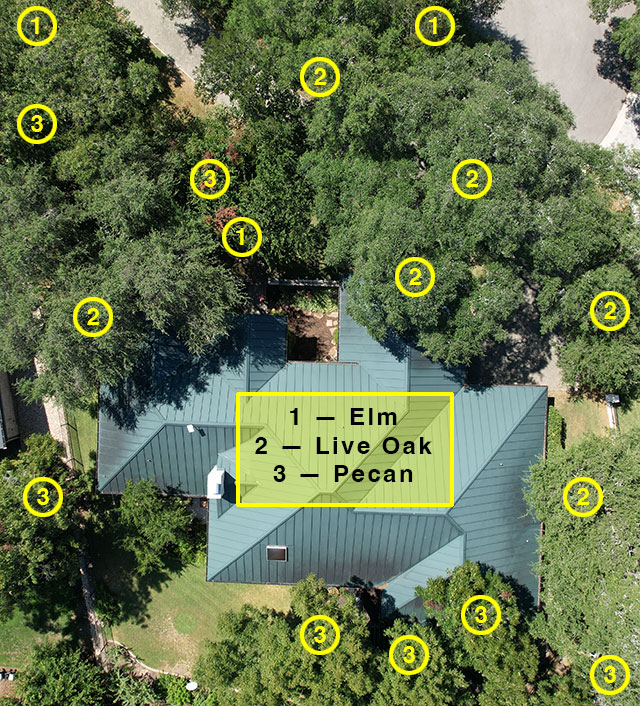
Below is an aerial view of our house and the lot on which it sits. The astute observer will note that the lot is populated with green organisms commonly known as “trees.” I’ve cleverly marked each tree with a number corresponding to its species.
Now, the things that trees typically have in common, regardless of species, are “leaves.” Leaves are essential for the viability of trees. They provide cooling shade in the middle of a hot Texas summer, and they beautify the scenery.
They are also often the bane of my existence.
Each of the three species of trees on our property will shed their leaves, but rarely at the same time. Clean-up is almost a year-round task, the exception being in the dead of winter when all the leaves have dropped. Of course, in our part of Texas, that lasts about three weeks. (Kidding; it’s more like six weeks.) But even then, the live oaks don’t shed their leaves…they wait until the spring to refresh their foliage.
During the heaviest leaf drop over the last couple of years, I spent literally hours raking them into piles, putting them into bags, and taking them to the city’s free brush disposal site (an amenity for which we’re all very grateful). The task was occasionally therapeutic in a pseudo-ASMR way, but always tiring and time-consuming. Before our cul-de-sac was completely built up, I could blow the leaves into the surrounding vacant lots, but now our narrow-minded neighbors fail to appreciate that practice. (Kidding; they’re all really great neighbors.)
Even though we’ve not yet had temperatures in the Forties, much less freezing, the pecan and elm trees are dropping leaves — and not all at once; it’s more like a death-by-a-thousand-cuts thing. I wrote about this phenomenon last year, in which the trees seem to go by the calendar rather than the weather.
About the same time the leaves and I began our inexorable descents — them to the ground and I into madness — ads for a leaf sweeper began to show up in my Facebook feed. The ads promised to make leaf raking and/or blowing a thing of the past, a relic from an unenlightened era. The demo videos were impressive, and despite my skepticism of anything that’s advertised via social media, I decided to take a chance. I figured that, if nothing else, I would get a blog post out of it.
So, I pulled the trigger on this bad boy, the Vevor Push Leaf Sweeper:
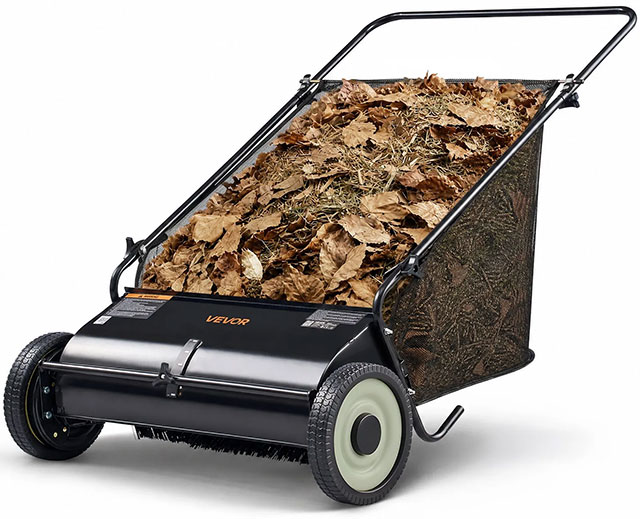
I ordered the 26″ model, primarily because the 30″ model was sold out. I did make the mistake of ordering from the company that was posting the Facebook ads, not realizing I could order directly from the manufacturer. That mistake cost me almost twice price listed on the Vevor website…but I considered even that a fair deal, IF it works as advertised.
How does it work?
Obviously, the manufacturer has solved the eternal challenge of teleportation, and its device sends lawn debris into another dimension, where it becomes someone else’s problem.
Just kidding…although we can keep hoping, now that we actually [almost] have flying cars. The actual mechanism is much less science-fictioney.
The lawn sweeper uses a series of stiff rotating brushes to sweep leaves, twigs, and — theoretically — acorns, pecans, and other debris into a hopper. The rotating brushes are geared to the wheels; there’s no motor involved. I made a short video to demonstrate the brush action.
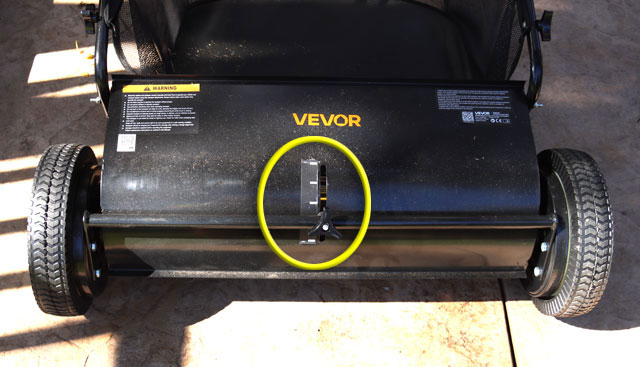
The ability to adjust the height of the brushes is absolutely essential. I quickly discovered that there’s a sweet spot between having the brushes too low (wasted physical effort to push the sweeper) and having them too high (debris is left behind). This will depend on the height, thickness, and evenness of the grass, if that’s what you’re sweeping. You can also sweep sidewalks and driveways, but those present a different challenge. We’ll talk about that again in a moment.
Well, does it really do the job?
Hey, that’s a great question! I anticipated your curiosity and I’ve documented my use in photos and a brief video.
The first photo shows the fallen leaves from the pecan tree that grows in the middle of the deck. This is actually a rather insignificant layer of leaves compared to what is to come.
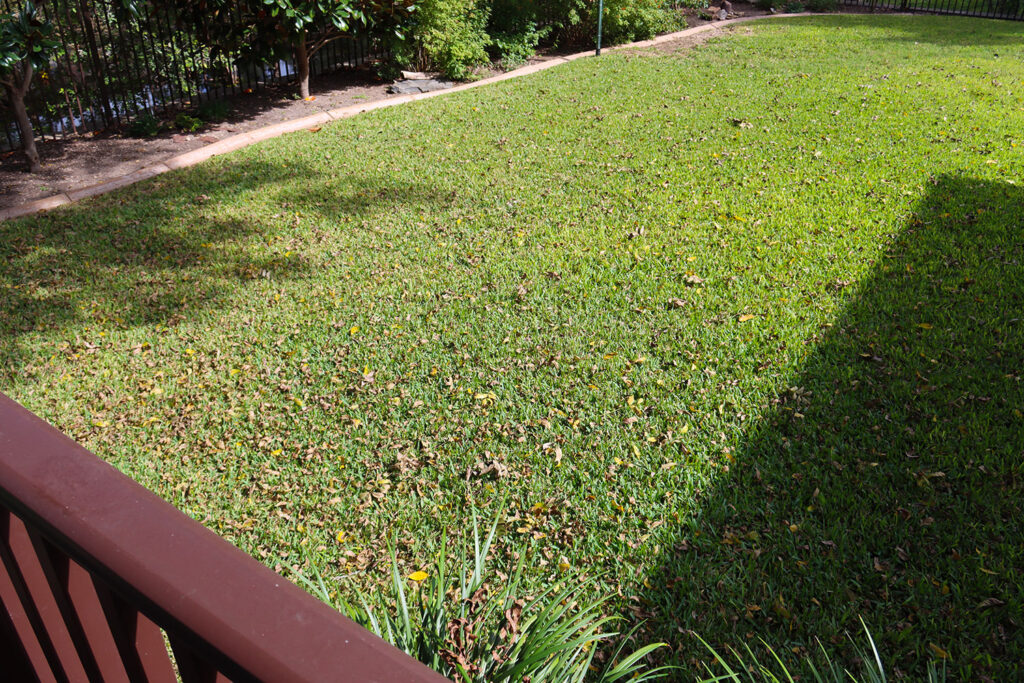
In the following video, you’ll see that I’m pushing the sweeper one direction, and pulling it in the opposite direction. This push/pull action is due to a couple of factors. First, our back yard slopes downward to the creek that runs behind our property. Second, I’m nursing a severe MCL sprain (hence the brace on my right leg), and I’m supposed to avoid excess exertion; as I quickly discovered, using this leaf sweeper falls into the category of “excess exertion,” as I paid a price for the effort. But I’m willing to sacrifice my own health for your benefit, dear reader.
The effort to push the sweeper uphill is fairly significant, even without a bum leg, so it was easier to pull it. The brushes don’t spin when the sweeper is pulled, so the resistance is greatly lessened; leaves are swept only on the downhill segments.
Here’s the result of the sweeping. I had to empty the hopper twice during this brief session. The hopper is easy to remove, although it takes a bit of practice to empty it into a trash bag without spilling some of the debris.
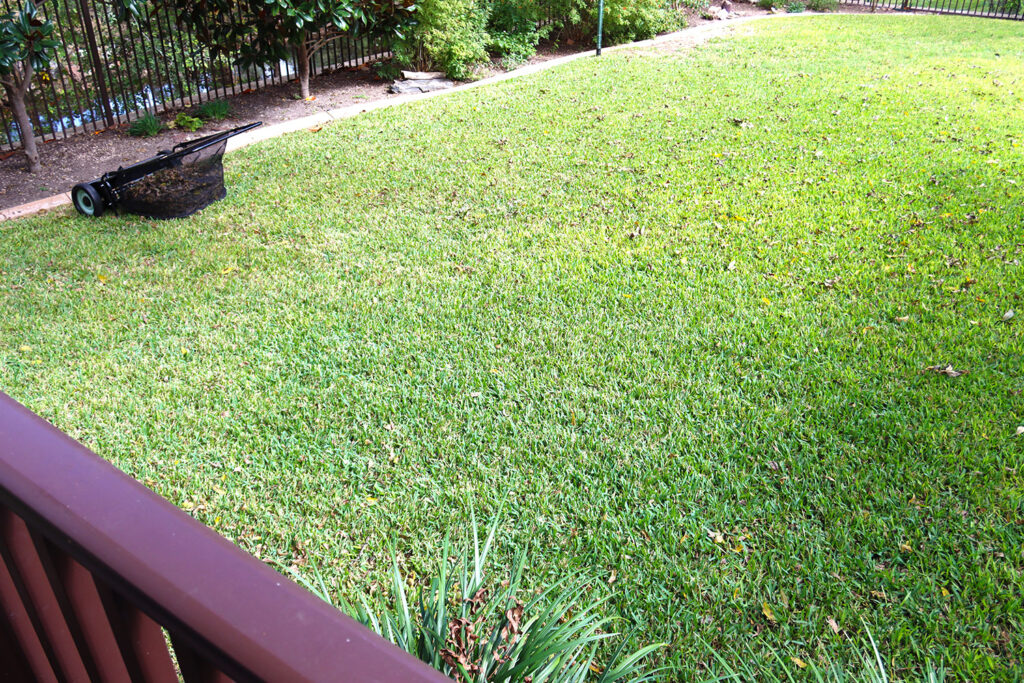
The leaves filled about half of the 55-gallon bag. Of course, they’ll compress into a much smaller space.
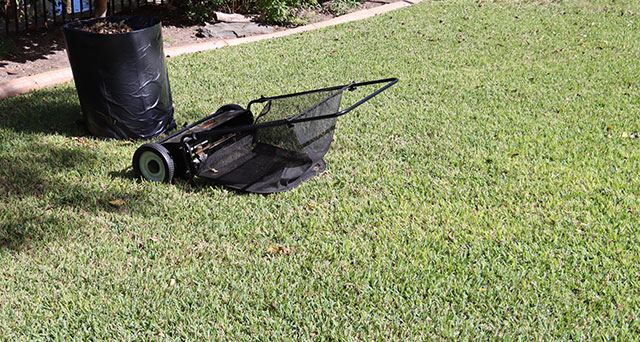
I feel I should add that even on the optimal setting for sweeping up leaves, the statement on the Vevor website that use of this equipment provides “effortless cleaning” is patently false. You’re probably too young to have ever used a manual reel mower, but, take my word for it, it’s far from effortless. The leaf sweeper provides the same level of workout, except it’s even heavier than most manual reel mowers. But, maybe a good workout is part of the appeal, you masochist.
What’s the verdict?
I have to say that overall, the leaf sweeper does an acceptable job of sweeping leaves from the lawn. The Vevor website states that it will sweep 80% of the debris in one pass. My brief demo actually did better than that, but I wasn’t trying to sweep up twigs, nuts and acorns, or grass clippings.
The sweeper is definitely not as effective as manual raking if your goal is to remove everything except grass. I would never recommend trying to de-thatch your lawn using the sweeper. At the lowest height setting, it would require a Herculean effort to push through a lawn, and I’m skeptical that even then it would effectively pick up thatch.
It’s also only semi-effective in sweeping debris from sidewalks and driveways, but for a different reason than you might think. While the brushes do a good job of sweeping debris off hard, flat surfaces, because of the design and placement of those brushes, they tend to throw some of the debris forward, away from the hopper. When testing the sweeper on the driveway, I estimated that only about half of the debris was thrown into the hopper on each pass. It’s certainly easier than using a push broom and a dustpan, but not nearly as effective.
I can’t help wondering whether it would be possible to design and attach a deflector of some sort in front of the brushing mechanism to keep the debris from being thrown in front of the sweeper. Please feel free to use your CAD and 3D-printing skills to come up with a solution.
Another weakness of the sweeper’s design is its inability to sweep next to a wall or fence. The wheels are set to the outside of the brushes, unlike those on a lawn mower, so there’s a 6″ strip next to a wall that won’t be swept. That’s not a huge issue for me; I can use a leaf blower to push leaves out from a wall or fence before using the sweeper.
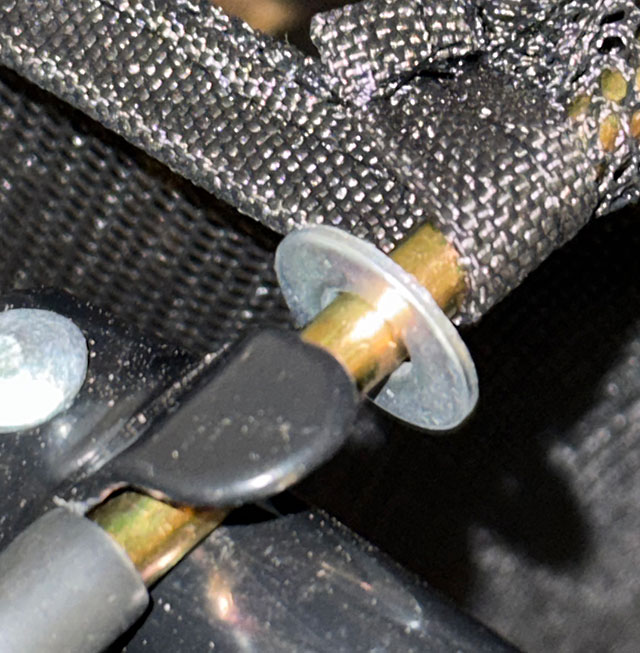
There’s one additional annoyance that many people have noted in their reviews, and it’s because of the way the hopper is fixed in place on the sweeper frame. There are two metal rods that slide through loops at the top and bottom of the hopper to provide rigidity and hold it in place. When the hopper is removed for emptying, the rods often slide out of the loops and it’s, well, annoying to have to put them back in place so the hopper can be reattached to the frame. I, too, experienced that annoyance, but unlike most (all?) of the complainers, I did something about it.
It’s a simple matter to slide a small washer between the removable rubber tip on the end of each rod and the fabric of the hopper. The washer prevents the rod from sliding through the loops on the hopper. Here’s a closeup of the solution:
A final potential challenge is the size and weight of the sweeper. The model I purchased doesn’t fold up, and it weighs about 35 pounds. It takes up at least as much space as a typical lawn mower, and perhaps more. If you have limited storage space, this might be a factor in your decision to get one.
There is a smaller model that weighs just under 15 pounds, but the capacity and sweeping width are also much smaller.
Summary
The Vevor Push Leaf Sweeper is a useful, albeit imperfect, tool for helping to keep your lawn relatively free of leaves.
Based on my limited experience with it, I recommend it if:
- You have a relatively level lawn;
- You’re relatively strong;
- You’re not particularly concerned about sweeping up anything but leaves;
- You have the space to store a somewhat bulky piece of equipment.
On the other hand, I don’t think it’s the right tool for the job if:
- You want to de-thatch your lawn;
- You have a recurring issue with fallen twigs or small branches;
- You want to use it primarily for sweeping streets, sidewalks, driveways, or patios;
- Your yard is overrun with fire ant mounds.
FWIW, I’m keeping mine and will use it through leaf-dropping season, which will end approximately 364 days from now.

AI Disclosure
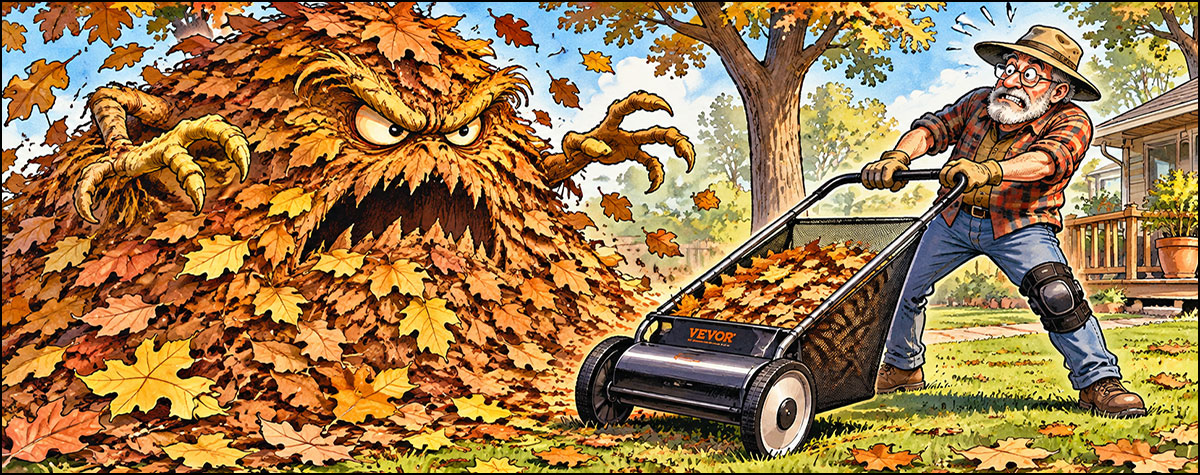
I used ChatGPT for copyediting of the final draft of this post. I also provided the prompt that ChatGPT used to create the header graphic.
Discover more from The Fire Ant Gazette
Subscribe to get the latest posts sent to your email.