
Note: I’m still on a blogging sabbatical until June 1st (it might end sooner…) but in light of current events and the presence of some potential misunderstandings, I decided to take a dive into a topic of primary importance in those events. I covet your indulgence.

I’m writing this in the middle of the US/Israel war against Iran. I have no interest in discussing my views on that conflict, but one aspect of it has sent me down a rather esoteric rabbit hole, and I’d like to drag you along with me.
For as long as I can remember (OK…no tacky comments, please), the discussions around Iran’s pursuit of nuclear weapons has always included references to the centrifuges that seem to be an integral part of the process by which uranium becomes fissionable, i.e. the part of a bomb that goes boom. But I’ve never understood how a centrifuge is used to create that material. The pursuit of that understanding is the impetus behind the story: the life cycle of Uranium-235, aka 235U, aka U-235.
Despite the possible over-dramatization of the post title, my goal is not to be prophetic or apocalyptic, but perhaps more professorial without being pedantic. The steps that begin with a mine of some sort and end with something called “highly enriched uranium” (HEU) — of which there is only an estimated 3 million pounds in the world — is at times mind-numbingly complex, but there’s something of a 50,000-feet view that makes it understandable.
So, if you’ll permit me, I’ll be your Mr. Peabody if you’ll be my Sherman and together we’ll try to remove the mystery from the process of creating a somewhat scary material.
By the way, this is actually a pared-down version of my original post. I was going to describe the full “life cycle,” beginning with mining and ending with enriched uranium, but two steps into the process, the post was more than 700 words, and — to borrow the wisdom of “Sweet Brown” Wilkins —ain’t nobody got time for that. But, if you really want to go through that whole life cycle, the US Energy Information Administration (EIA) website does a great job of summarizing the steps. Note, however, that its flowchart is designed to explain how fuel for nuclear reactors is produced; we’re focusing on the production of weapons-grade material.
Table of Contents (for the impatient reader)
- What is Uranium-235?
- Let’s Make a Cake
- Enrichment: It’s Getting Serious
- Gas Centrifuges: Molecular Merry-Go-Round Mayhem
- That’s the Theory; What’s the Reality?
- Bottom Line(s)
But first, what is Uranium-235?
Uranium is a chemical element which in its pure form is a silvery-white metal. It’s more dense than lead, but somewhat less dense than gold. It’s one of 28 naturally-occurring elements that are radioactive. It may be the most well-known, along with plutonium and radon, but you might be surprised to learn that other common elements such as iodine, carbon, calcium, and potassium also have radioactive isotopes.
An isotope is essentially a “sub-species” of an element with a different number of neutrons than the “base species.” This distinction is important for our discussion because uranium exists in the form of multiple isotopes, some naturally occurring, and others the result of chemical manipulation. The most common isotope is called U-238. It occurs naturally and comprises 99+% of the uranium on earth. It’s also non-fissile, meaning that it can’t be used to produce a thermonuclear reaction, i.e. atom bomb.
The isotope of major interest to us is U-235, which makes up only about 0.72% of naturally-occurring uranium. But it’s the fissile isotope that can sustain a nuclear chain reaction, and it can be manufactured in higher quantities by the process we’ll attempt to uncover.
Geeky, but essential detail: U-238 has 146 neutrons; U-235 has 143. It’s the number of neutrons that always distinguishes one isotope of an element from another.
Let’s Make a Cake
Are you familiar with the term yellowcake? No, it has nothing to do with Betty Crocker, and you might be as surprised as I was to learn that it’s not always even yellow.
Once uranium is mined, it’s then milled (see the EIA web page linked above for details) and the ore is converted to what’s called yellowcake. This product is then subjected to a multi-step chemical process called conversion, which introduces fluorine gas to produce uranium hexafluoride (UF6). UF6 is initially a gas, but it’s gradually cooled, first becoming a liquid and then, finally, a solid, at which point it’s ready for enrichment.
Geeky, non-essential detail: According to the EIA, a ton of ore typically yields only one-to-four pounds of yellowcake, the scientific name for which is Triuranium octoxide, represented as U3O8.
Enrichment: It’s Getting Serious
Enrichment is the term applied to the process by which UF6 is converted to the material appropriate for its planned use, which is typically either for nuclear reactor fuel or for nuclear weapons. The fundamental goal of the process is to separate the component isotopes of the uranium, and then to increase the proportion of U-235 according to intended use.
The process is essentially the same for either fuel or weaponry. In what is probably an oversimplification, the difference is in the point at which the process stops. This is where we can start talking about the centrifuges that started us down this path.
Gas Centrifuges: Molecular Merry-Go-Round Mayhem
Sorry for the dumb heading, but it’s not totally inappropriate. Remember when we learned that UF6 (uranium hexafluoride) was initially a gas but was allowed to cool to the point where it became solid? That process simply allowed the uranium to be transported to the enrichment facility. At that point, it was reconstituted into gaseous form, and the enrichment process could begin.
At the current time, there are three types of processes for enriching uranium, and you can learn about all three via the US Nuclear Regulatory Commission’s (NRC) website. The use of gas centrifuges is the most common approach and the most easily understood, at least to my simple mind, mainly because it’s a more straightforward physical, machine-oriented process. (Having said that, the reality is significantly more complex; feel free to peruse this article to see what I mean.)
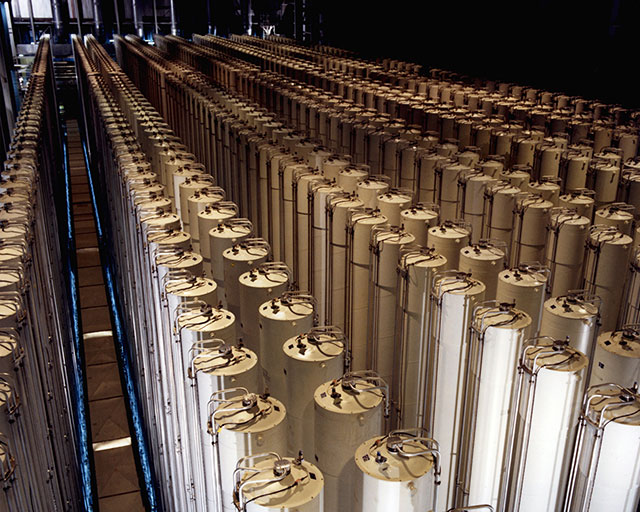
Now, UF6 is overwhelmingly comprised of the more “inert” U-238 isotope, with the desired U-235 isotope being a tiny fraction of the sample (along with an even more minuscule amount of another isotope, U-234, which is of no concern to us for this discussion). Alert Gazette readers will recall that U-235 atom has three more neutrons than U-238 (math isn’t always hard), giving it more mass. So when the UF6 gas is put into a centrifuge and spun at an incredible speed (more than 50,000 revolutions per minute), the heavier molecules containing the U-238 atoms are thrown to the outer region of the centrifuge body, while the U-235 atoms remain closer to the center of the vortex. Through the application of advanced technology that’s indistinguishable from magic, each of these two layers can be funneled away and subjected to additional processing.
The stream containing the U-235 is sent to the next centrifuge (the series of devices is referred to as a cascade) where it’s further concentrated and sent to the next device, and so on until the desired concentration is achieved. It requires literally multiple thousands of centrifuges in these enrichment facilities to achieve high concentrations of U-235.
Concentrations of 3%-5% U-235 are referred to as Low Enriched Uranium (LEU) and are commonly used in nuclear power plants. Once the concentration of U-235 exceeds 20%, it’s considered to be Highly Enriched Uranium (HEU), and further enrichment to 90%+ puts it into the weapons-grade category.
At the end of the enrichment process, the uranium hexafluoride gas is captured and cooled into either a liquid or solid form (depending on how it will be stored and transported). The final steps in the process convert the fluoride compound into an oxide or halide (don’t worry; we’re not going there), with additional thermal and chemical reactions (not there either) required to reduce it to a final metallic composition where it can be shaped for use in a weapon.
Geeky but non-essential detail: The exact speed of modern centrifuges is something of a classified secret, but it’s not a secret that the bearings on which the centrifuges spin are mounted in magnetic suspensions to reduce contact, as the high speeds would otherwise quickly destroy them.
That’s the Theory; What’s the Reality?
I’m glad you asked (I heard you think the question). We could delve into how many countries have the capability of producing weapons-grade uranium (or plutonium — that’s a whole other fascinating topic), and look at the estimates of how many gas centrifuges each one possesses. But, really, what is uppermost in my mind is Iran’s status and capabilities. After all, the US is engaged in warfare (at the time of this writing) in an attempt to destroy or at least significantly reduce Iran’s nuclear capabilities.
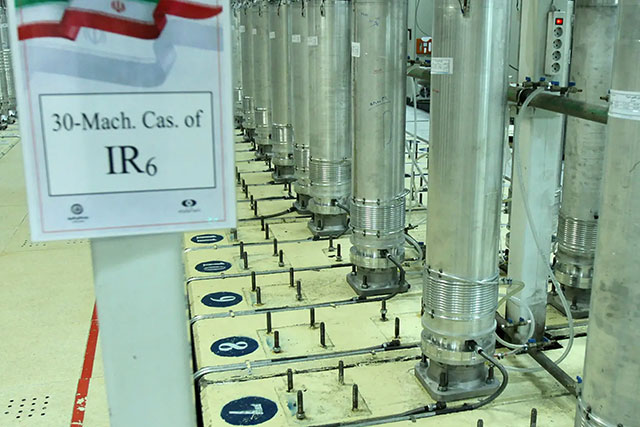
A year ago, Iran had an estimated 22,000 gas centrifuges of varying models and capabilities. It’s unknown at this time how or if that number has been significantly impacted by the current military actions. Most of those centrifuges are relatively old and inefficient models, although it also has some new models (see photo below) that allow it to speed up the production of weapons-grade uranium.
The good news is that as far as can be determined (and disclosed; some data may well be classified and unavailable to the common blogger on the street), Iran has not actually produced any weapons-grade uranium. The bad news is that it does possess a sufficient quantity of 60% enriched uranium that it could continue the enrichment process and achieve the 90%+ level in just a few weeks, sufficient for making a handful of nuclear weapons — or 5-8 nuclear warheads, according to the researchers at Iran Watch. (According to this fact sheet from the Center for Arms Control and Non-Proliferation, once enrichment hits 20%, further progress can come very quickly.)
In April, 2026, President Trump used the term nuclear dust to apparently describe the Iranian stockpile of highly enriched uranium or, possibly, the remains of such after destruction by military action. This term should be viewed as a political colloquialism, as it is not a legitimate scientific or industry term.
Bottom Line(s)
Keep in mind that while I began this lengthy post with no intention of getting into the political aspects of the issue, a focus on the scientific components inevitably led to the overarching context of why it matters.
Given all of this, I’ll leave you with two mostly unrelated thoughts. First, the enrichment process for uranium is complex and that complexity is probably why only a handful of countries have the capability of implementing it. Second, some of those countries pose real threats to our country, and we ignore that reality at our own considerable risk.
As Pogo said, we have met the enemy and he is us. Carl Sagan had a similar, if more eloquent way of stating it:
We live in a society absolutely dependent on science and technology and yet have cleverly arranged things so that almost no one understands science and technology. That’s a clear prescription for disaster.
I doubt that most of you are interested in spending another twenty minutes on this topic, but in case I’m mistaken, you might find the following video helpful.
Discover more from The Fire Ant Gazette
Subscribe to get the latest posts sent to your email.
Hi Eric
Your old neighbors
Sandy&Gary Howard
Hi, Sandy and Gary…it’s nice to hear from you! Hope you both are doing well.
Wow, I learned a lot! Audrey
Audrey, I figured you already knew all of that stuff! 😀
Eric, your intellectual curiosity is greater than anyone I have ever known personally……and that includes my lovely wife! And that, my friend, is saying something!