
Look*, I know the post title is an oxymoron, at least for people like me (and, possibly, you — I hope for at least some of you, which will make me feel better, albeit at your expense). I don’t understand advanced math, which I define as essentially anything that’s not basic algebra (or simple arithmetic; I like arithmetic). I managed to get a C in undergrad calculus and I was ecstatic at that achievement, and I’m sure I can run a three minute mile before I can solve a quadratic equation.
So you should be as puzzled as I am as to why I googled hardest math problems in the world yesterday.
*Irrelevant aside — Have you noticed that many of the talking heads on TV now preface their statements with “look”? I have, and it’s annoying. Psychologists say that it’s an attempt to force the listener to accept as fact an unproven premise, and to make us think the speaker is normal and “no-nonsense.” Thanks to its overuse, it achieves none of those things. But, look, there are exceptions.
That led me to this web page with the creative title of What’s The Hardest Math Problem in the World?. Google is nothing if not literal. This site ranks nine famous (to somebody, I guess) and as yet unsolved problems, starting with the Riemann Hypothesis.
As far as I can tell, the main reason this problem needs to be solved is so that some things involving prime numbers that are believed to be true will then be known to be true. I don’t know; it sounds like we need to solve this problem so we can say we solved this problem. Anyway, as soon as I hit the reference to the Riemann zeta function, my eyes refused to focus until I moved to #2.
Number two on the list is the P vs. NP Problem, which has real world implications because it might help us get better at Sudoku. According to this website, it would also help us to determine the shortest path on a graph; I guess using a ruler is considered unsophisticated. Unfortunately, this is another problem that nobody seems to be able to get a handle on so we’ll continue to be bedeviled by those wily Japanese gamesters, and suffer the embarrassing consequences of eyeballing lines on our graphs.
Having stumbled past the first two, I landed on number three, and found myself shouting (in my head, of course) Eureka! because the Collatz Conjecture — named after a German mathematician, Lothar Collatz (1910-1990) — is a problem that (a) I can’t solve, but (2) I can test it, and at least understand the process behind it.
Simply put, the Collatz Conjecture works like this (from the How Stuff Works website):
Start with any positive integer. If it’s even, divide by 2. If it’s odd, multiply by 3 and add 1. Repeat with the result of the previous calculation. The Collatz Conjecture posits that no matter what number you start with, you’ll eventually reach 1.
I decided to try this out for myself, and I chose to start simply, with the number 3. I opened a blank Excel spreadsheet, entered 3 on the first row, and got to work. Second row (or first iteration) is 10 (3 x 3 + 1). Third is 5 (10 ÷ 2)…and so on. The seventh iteration yielded — wait for it — 1. So far, so good…the Collatz Conjecture is true for the number 3.
I felt cocky, so I picked another number at random. This time it was 27. First iteration: 82 (27 x 3 + 1). Second iteration: 41 (82 ÷ 2). Third…well, let’s just say that things got out of hand quickly. By the time I got to the 77th iteration, we were up to 9,232, and I was beginning to doubt my commitment to the exercise.

However, as I recently said, I have time as a retiree to watch lizards, so surely I can also carve out a few more minutes (I hope) to help mankind by proving the Collatz Conjecture…at least with respect to the number 27. I trudged onward and reached my final destination (i.e., the number 1) at iteration #111. That 77th iteration proved to be the maximum value in the entire sequence.
Now, I did those two computations manually in Excel, but I figured there had to be an easier way. I was sure there was a way to use Excel’s powerful functions to create an equation that would test each preceding result to determine whether it was even or odd, and then apply the proper calculation of the next number in the sequence.

So I determined to figure that out in the simplest possible way: I cheated — I asked ChatGPT to do it for me. Turns out that Excel has a one-trick pony function called MOD() whose sole purpose in life is to test a number and decide if it’s even or odd. I had no idea of MOD’s existence, despite having used Excel for decades — since it kicked Lotus 1-2-3 to the curb (so, almost forty years, for you youngsters). And not once during that time did I ever need a spreadsheet function to distinguish even from odd. As ChatGPT put it, you’ve now encountered one of my favorite categories of Excel functions: the ones that are completely unremarkable until suddenly you realize, “Wait a minute…this is exactly what I need.”

If you’re wondering just how the MOD() function works — and I know you are, inquisitive Gazetter — it’s really quite simple. The function returns the remainder when a number is divided by 2. If the remainder is 1, the number is odd; if the remainder is 0, it’s even. Thus (the numbers being tested are bolded)…
- MOD(10,2) → 0
- MOD(11,2) → 1
- MOD(27,2) → 1
- MOD(9232,2) → 0
Ready to play around with this on your own? Here’s how to get started. Open Excel, choose a number, and enter it in cell A1. Copy this formula into the second row, same column:
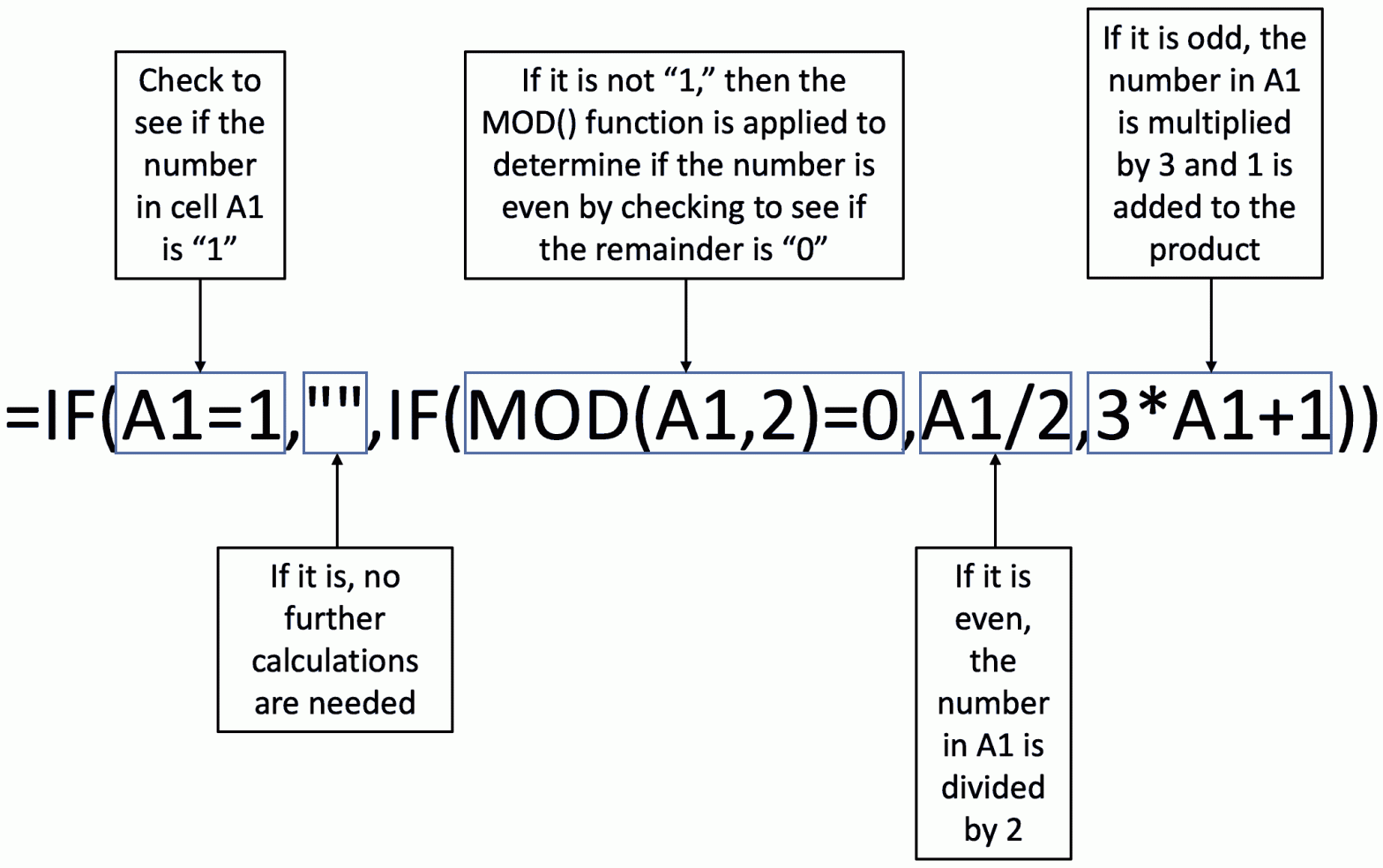
=IF(A1=1,””,IF(MOD(A1,2)=0,A1/2,3*A1+1)) [footnote]
Then continue copying the formula — you can simply just drag the formula downward; the references to the prior cell will automatically update — into subsequent rows until the result is 1.
You might be surprised at the results from choosing different numbers. I theorized that the bigger the starting number, the more iterations it would take to get to 1, but that’s not remotely the case. For example, while starting with 27 required 111 iterations, starting with 16,748 required only 66 — 45 fewer (see, I can do math!). Even beginning with 183,000,281 required only 157 iterations to get to 1.
And here’s a fun thing to try, fun being a highly subjective thing, of course: think of two seemingly unrelated, random numbers for which the first iteration yields an identical result, and you’ll [obviously] find that it will take the same number of iterations to reach 1. Thus, beginning with either 27 or 164, because the 1st iteration for each is 82 (27 * 3 +1 and 164 ÷ 2). According to ChatGPT, mathematicians commonly describe these pairs of numbers as having merging trajectories or say that their Collatz orbits coalesce/merge.
I want to close by circling back to the original issue: why hasn’t this problem been solved already, since it appears so simple? According to this 2025 article (PDF) in the Journal of Supercomputing, the problem has been computationally verified for every starting integer up to:
2,361,183,241,434,822,606,848 (or 271)
That’s 2 sextillion and change, a number that even Elon Musk will envy. The issue limiting testing numbers larger than that is simply one of computing power. The current computations were done using Nvidia and AMD GPUs, installed into multiple European supercomputers, and which the scientists found were 52x faster than their best CPU implementation.
As far as I’m concerned, 2 sextillion successful tests are all the proofs needed to pronounce the Collatz Conjecture solved. But I’m easily swayed, and not a mathematician. I’m sure that as computer technology advances, so will the ability to extend the testing.
Until then, what I really care about is something that will improve my Sudoku performance.

[Footnote] If you’re unfamiliar with how Excel’s functions are used in formulas, perhaps the following graphic will be helpful in understanding the application of the MOD() function. You can click it to see a larger version.
Disclosure: How I used A.I. to create this post
As I’ve disclosed in the post, I used ChatGPT to help with the implementation of the MOD() function in Microsoft Excel. I also submitted a final draft for its review as a copy editor (vs. as an editor), primarily to make sure I hadn’t missed some typos or misspellings (I had). However, it also pointed out a few areas where I had misunderstood some of the facts and theories related to these math problems, or where my explanations were unclear or even incorrect or misleading. So, it actually ended up being both copyeditor and editor.
I have an ongoing internal debate as to the need and usefulness of disclosures like this. I will always flag images that were created via A.I., and I will never use A.I. to write for me (except to demonstrate its capability to do just that). But I don’t disclose where autocorrect has worked its magic (or malice, IYKWIM); nor where a search engine’s A.I. has enhanced an explanation of a subject for which I’ve sought additional information or education; nor where my increasingly annoying failure to find just the right word leads me to a website displaying synonyms. Those things are essential in any [modern] writer’s toolbox, and a case could be made that a final scan by an A.I. bot of a draft article is just another of those tools.
I’d be very interested to know what you, dear reader, think about this question: is it better to “over-disclose” A.I. usage, or limit such disclosure to areas that have been significantly generated by A.I.? (Never mind that that raises many more questions. We have to start — or stop — somewhere.)
Discover more from The Fire Ant Gazette
Subscribe to get the latest posts sent to your email.