
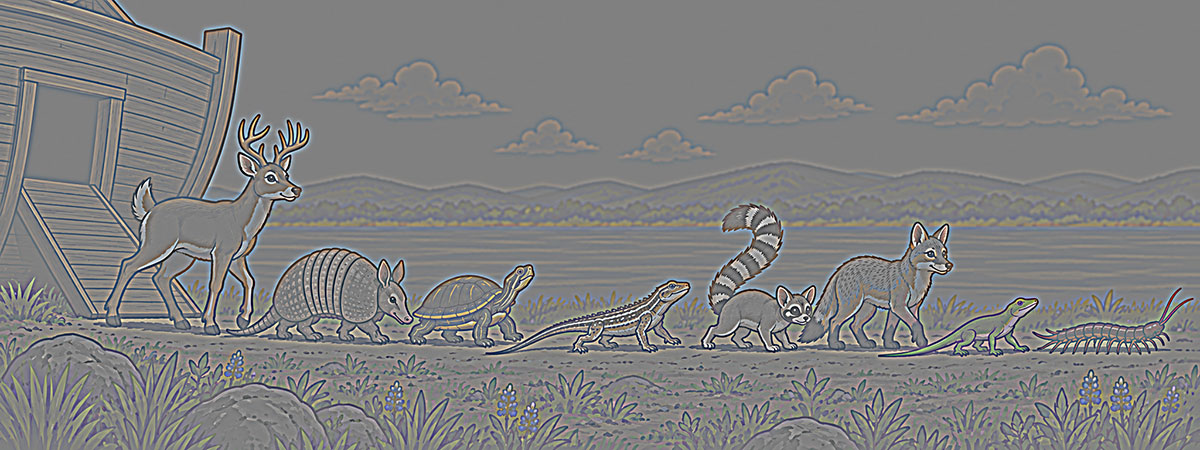
If you’ve spent any time at all perusing the Gazette, you know that one of my favorite topics is the documentation and discussion of the wildlife that inhabits our little corner of the Texas Hill Country. It recently occurred to me that I’ve never attempted to create a kind of master list of animals that have visited our property (or been in close proximity to it). What follows is my attempt to do just that.
I’ve selected almost thirty species of vertebrates (with one exception, and with the exclusion of birds), each of which I’ve had the privilege of observing either live or via a photo taken with my trail camera. I’ve put them into the following categories: Snakes, Lizards, Mammals, and Miscellaneous. For each species, I’ve provided the common name and the scientific name.
The scientific name for each is linked to an external website dedicated to that species, providing detailed information about it. The linked websites are almost exclusively Wikipedia pages; there are a couple of non-Wiki websites that I judged to be more accurate and relevant. In addition, as you hover over (desktop) or click (mobile) the links, you’ll be presented with a popup with an overview and small photo of a member of each species [0].
Again, this post describes sightings of species in our specific locale. I hope it will be useful for those of you living in Central Texas (and especially in the Highland Lakes region), as you stand a good chance of seeing these critters yourselves.
| Common Name | Scientific Name |
Snakes | |
| Dekay’s brown snake |
Storeria dekayi
The DeKay’s brown snake is a small (generally less than 12″) non-venomous species of snake in the family Colubridae. The species is native to North America and Central America. They feed on snails, slugs, and earthworms and thus are beneficial. 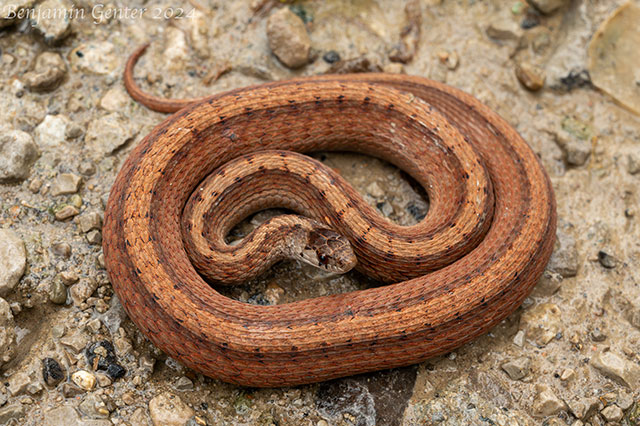 |
| Diamondback water snake |
Nerodia rhombifer
The Diamondback water snake is a common, non-venomous species found in the central US and northern Mexico. Length is generally in the 3-4 feet range. Its primary habitat is slow-moving water such as stream and ponds, and its diet consists mainly of fish and frogs. 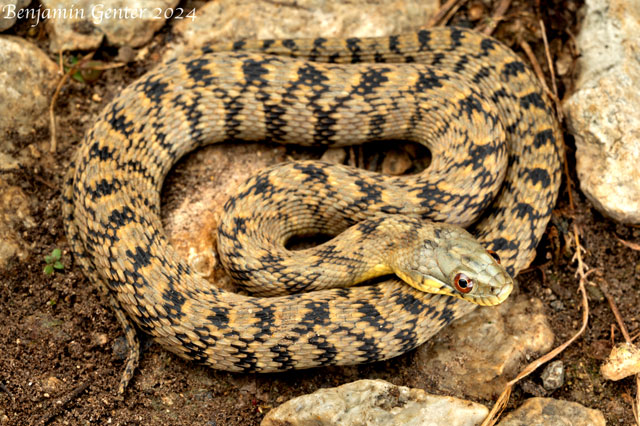 |
| Eastern hognose |
Heterodon platirhinos
The Eastern hognose is a mildly venomous, rear-fanged species whose range extends from Central Texas to the East coast. Its venom is prey-specific (it feeds on amphibians) and is harmless to humans, although some people might have an allergic reaction. The hognose is known for its dramatic “faking death” behavior when it feels threatened. 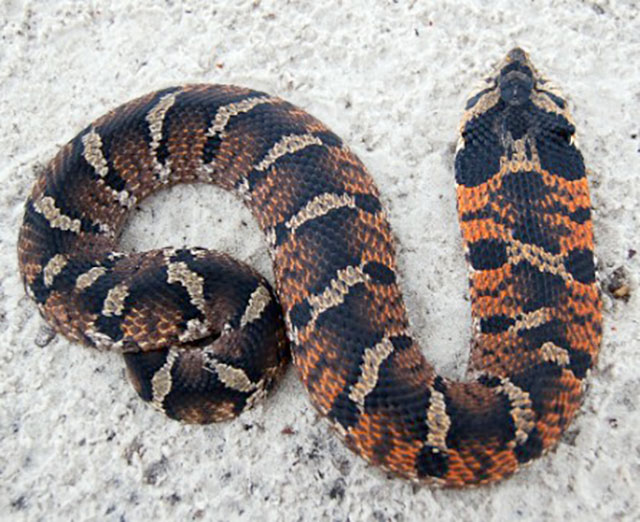 |
| Northern cottonmouth |
Agkistrodon piscivorus
The Northern cottonmouth (aka water moccasin) is a venomous semiaquatic pit viper. It is rarely longer than 3′ and has a thick body that quickly narrows to its tail. Juveniles are colorful, but the colors fade and darken as the snake ages. Its name comes from the white lining in its mouth, which it displays when threatened. Its venom is fairly powerful but is effectively treated with antivenom, and deaths are very rare. It is carnivorous, and will even eat carrion. It has an undeserved reputation as aggressive. 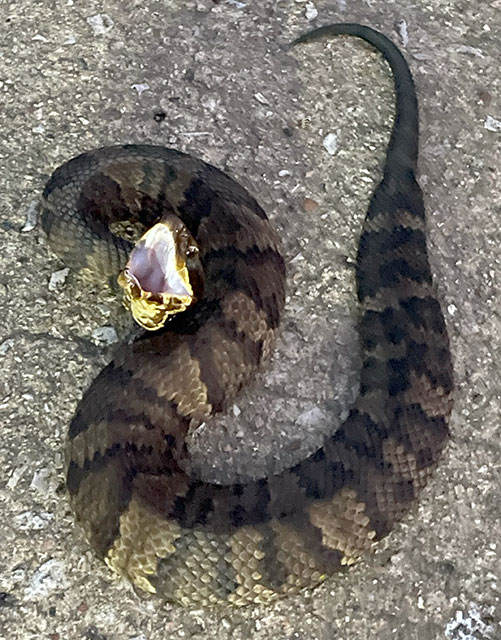 |
| Plain-bellied water snake |
Nerodia erythrogaster
The Plain-bellied water snake is a non-venomous semi-acquatic species endemic to the US; its range encompasses all southern states from Texas to the east coast. It grows to an average length of 48″. It may be spotted on land or even resting on a tree limb over water, but it will primarily be found in the waters of a slow-moving creek or in a pond. Its diet is primarily fish and amphibians. It is unfortunately often misidentified as a venomous cottonmouth and killed. 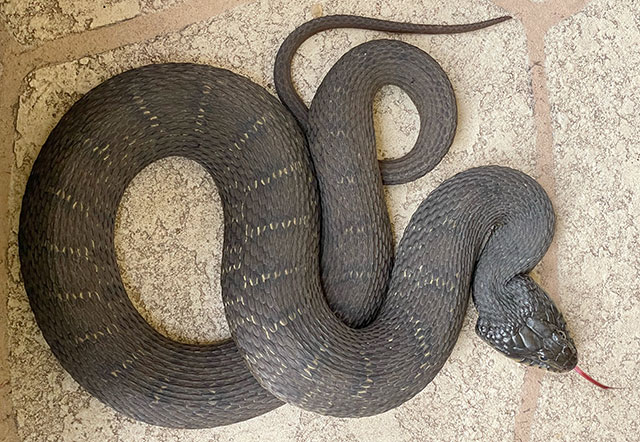 |
| Western coachwhip |
Masticophis flagellum
The Western coachwhip is a non-venomous species found throughout the US and Mexico. It has a long, slender body, typically light brown in color, and can grow to a length of 6′ or more. It is very fast moving (up to 4 mph), and is known for “periscoping”…raising the its head in the air to look over surrounding brush or rocks. It will strike and bite when cornered but prefers to escape. 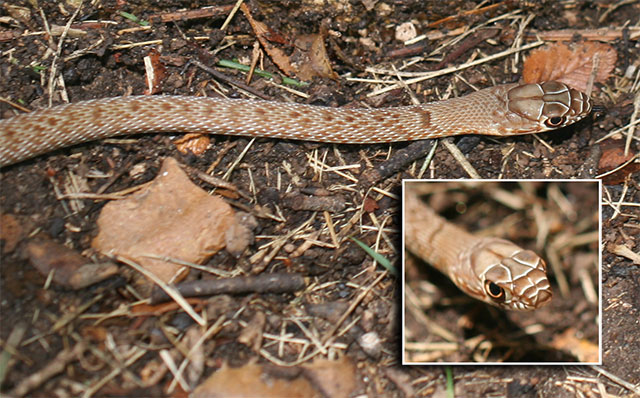 |
| Western rat snake |
Pantherophis obsoletus
The Western rat snake is a non-venomous species found in the US west of the Mississippi River. Its coloring varies widely, but is primarily in shades of brown with patches of black. It prefers wooded areas, and is an excellent climber, known to scale vertical walls and fences. It can grow to a length of 6′ and more. It is a constrictor, and feeds on almost any animal or bird it can catch; it’s also a notorious egg eater. It will strike and bite if cornered, but prefers to escape. 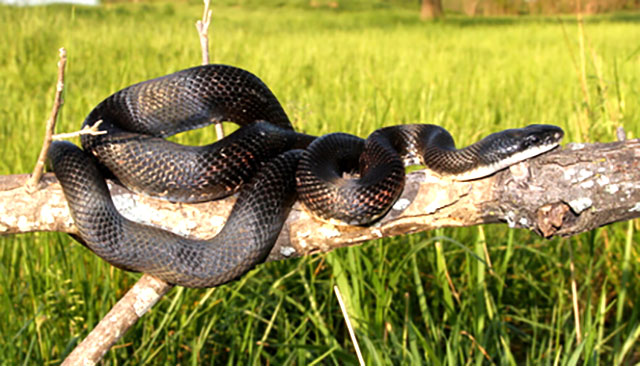 |
| Western ribbonsnake |
Thamnophis proximus
The Western ribbon snake is a slender, harmless species of garter snake found in the central and southern parts of the US. It’s is part of the garter snake family. It can grow to a length 48″, and can be distinguished from other snakes in the family by the distinct white dot on the top of its head. Its diet consists primarily of amphibians, fish, and insects. 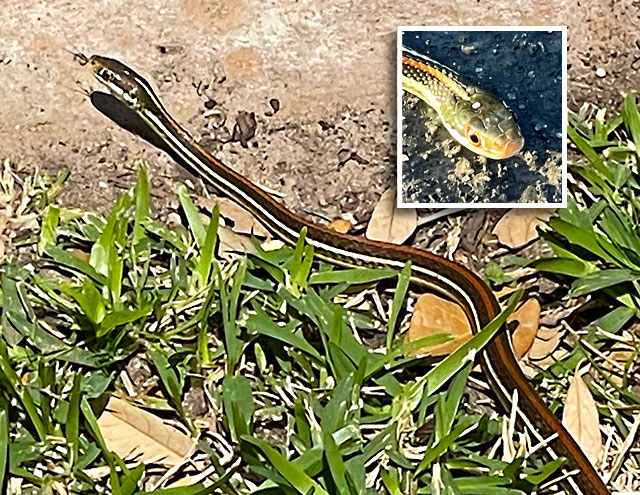 |
| Lizards | |
| Green anole |
Anolis carolinensis
The green anole is a small lizard commonly found throughout the southern US. While not a true chameleon, it can change color (several shades from brown to green). Both sexes have dewlaps (throat fans), but the male’s is much larger and is bright orange or red. Females have a white zigzag stripe down their backs. The males are highly territorial and will fight each other. Anoles primarily eat small insects and spiders. 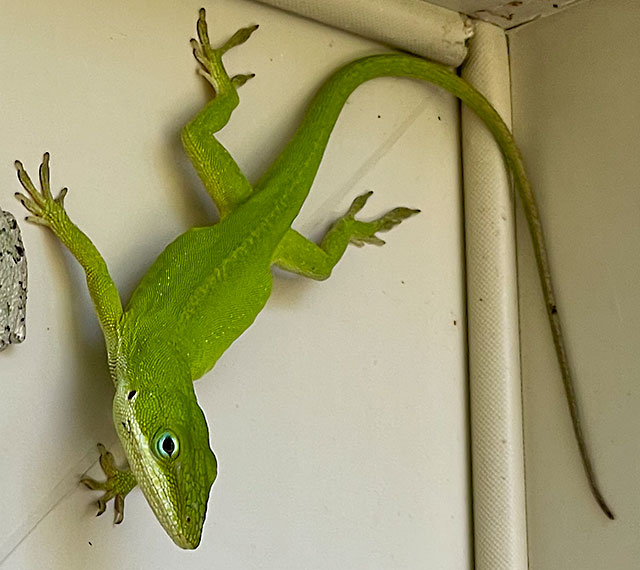 |
| Mediterranean house gecko |
Hemidactylus turcicus
The Mediterranean house gecko is a small (4-5″) lizard that is generally light-colored but often has dark mottling; its skin is bumpy. The species is considered invasive, having been introduced from southern Europe and north Africa. However, there are no known issues associated with its presence in the US. The gecko is nocturnal, and eats insects and spiders. They are often spotted on the side of walls under lights, catching insects. They have sticky toepads, vertical pupils, and lack eyelids. 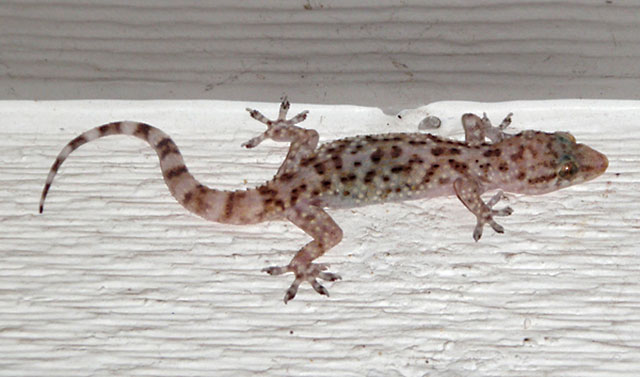 |
| Six-lined racerunner |
Aspidoscelis sexlineatus
This fast-moving species of lizard is found in most US states east of the Rockies. Adults average around 11″ in length. The name refers to the six yellow or yellowish stripes that extend from head to tail. The species is active during the day and feeds exclusively on insects and spiders. It can be mistaken for a spotted whiptail, as they are both in the same Family (Teiidae). 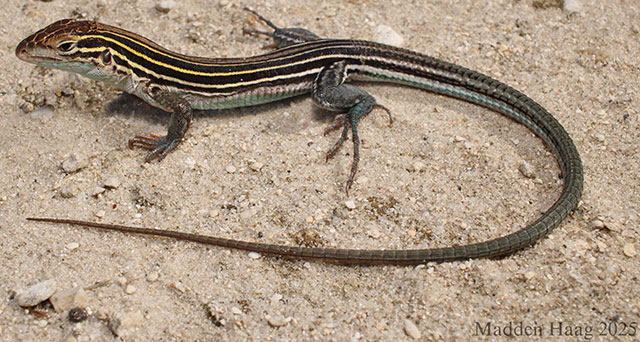 |
| Texas spiny lizard |
Sceloporus olivaceus
This lizard is native to south central US, including Texas, Arizona, and Oklahoma. It is often found on fences and trees; it is a very good climber. It grows to a length of up to 11″. Males can be identified by blue patches on the sides of their bellies. It is active during the day and prefers mesquite or oak trees. Diet is almost exclusively insects and spiders, although they will occasionally eat tiny arthropods or small lizards. They are ambush predators; they will wait motionless and patiently for prey to come close enough to capture. 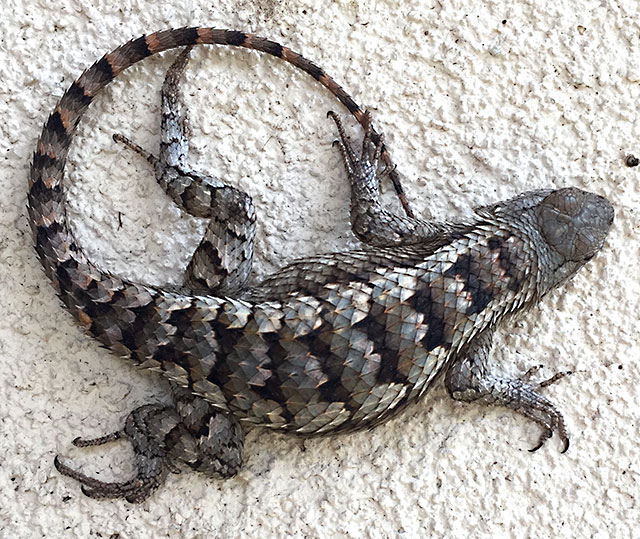 |
| Texas spotted whiptail |
Aspidoscelis
gularis
This lizard is endemic to Texas, New Mexico, Oklahoma, and northern Mexico. It grows to a length of 11″. It has seven white or gray stripes running the length of the body, and light colored spots along its sides. It is a fast-moving lizard and can be mistaken for a six-lined racerunner, as it is in the same Family. It is insectivorous and actively moves along the ground during the day seeking prey. It can shed its tail to escape a predator; the tail will regenerate. 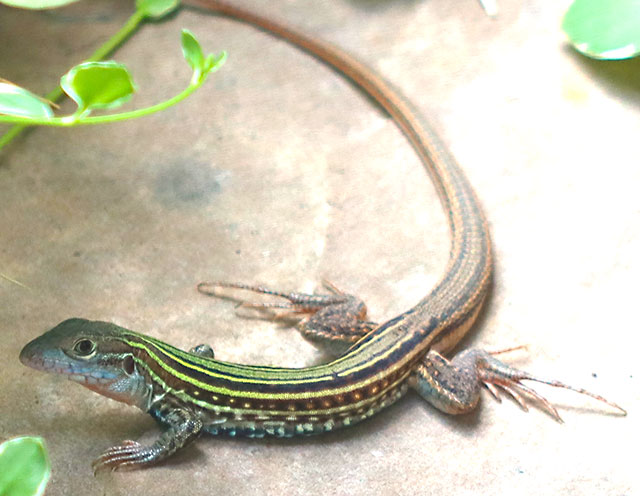 |
| Mammals | |
| Bobcat |
Lynx rufus
The bobcat is native to North America but ranges as far as southern Mexico. It can grow up to 4′ in length, about 2′ in height, weighing up to 40 pounds for males and around 30-35 pounds for females. They adapt to a variety of environments, although they prefer woodlands. Preferred diet consists of rabbits, but will include any small mammal (and even deer), as well as birds and insects. They are crepuscular (most active during twilight and around dawn), but are occasionally spotted throughout the day. They are shy and not aggressive toward humans unless provoked or sick. 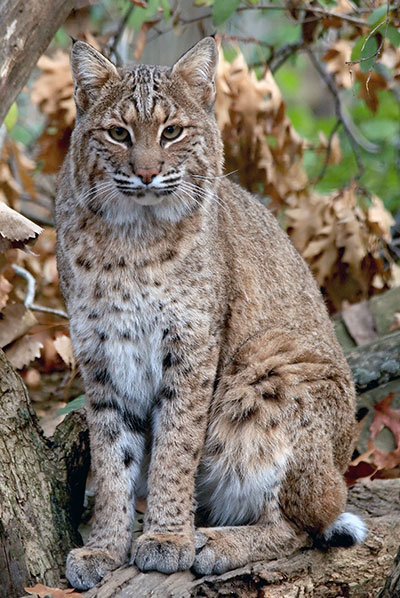 |
| Eastern fox squirrel |
Sciurus niger
Fox squirrels are found in almost every state in the U.S. with the exceptions of New England, and a couple of other northeastern states. They are considered to be an invasive species in Europe and cannot be imported or released in the EU. These squirrels are omnivorous and will eat insects, eggs, and birds, as well as nuts, fruits, and fungi. They are diurnal and non-territorial, but not particularly social. They also have a large vocabulary. 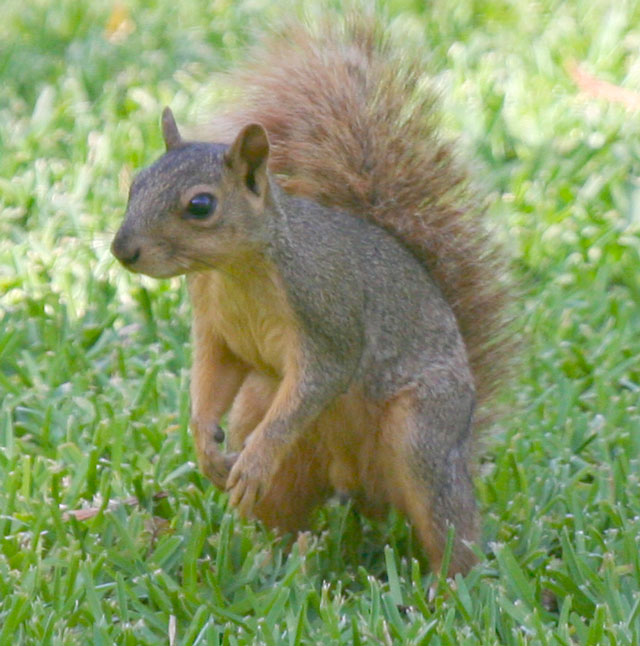 |
| Gray fox |
Urocyon
cinereoargenteus
The gray fox is widespread throughout North and Central America. It is relatively small, averaging about 10 pounds and about 3’ in length (males). It’s omnivorous, eating almost live prey it can catch, as well as fruit or carrion. It’s an excellent climber and is most active starting at dusk and throughout the night until dawn. Females will give birth to litters of 1-7 kits (average is ~4). Foxes can contract and transmit rabies; signs include unusual aggression toward people and pets and disorientation. 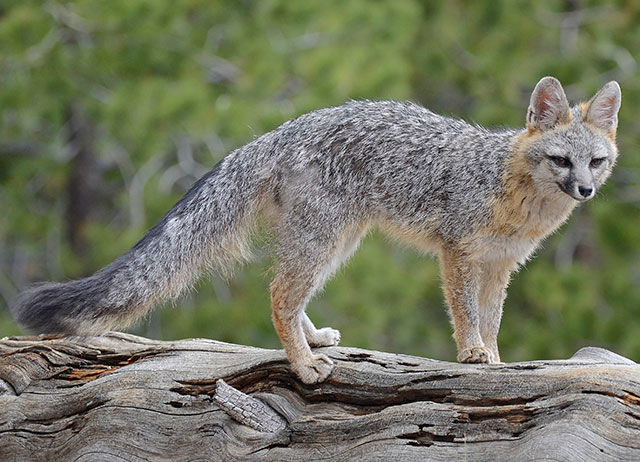 |
| Mexican long-nosed armadillo [1] |
Dasypus mexicanus
The armadillo is primarily an insectivore, using its keen sense of smell to locate and dig up termites, beetles, and grubs. It’s also been known to eat turtle and bird eggs, as well as fruit. Armadillos average about 10 pounds in weight; total length is up to 3.5 feet. They can jump straight up to a height of almost 4′ when startled. They are strong swimmers, and are most active during nighttime hours, although they can be spotted during the day. Reproduction is in the form of identical quadruplets of the same sex. 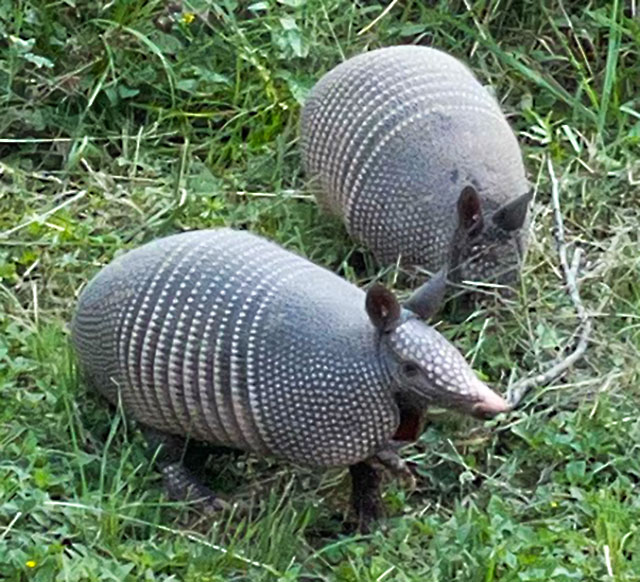 |
| Texas raccoon |
Procyon lotor fucipes
Raccoons are native to North America and are found in every state in the U.S. The species has a wide variety in size, with lengths up to 30” and weights up to more than 50 pounds. They have adapted to a wide range of habitats, including urban areas. The Texas raccoon is one of 22 subspecies; it is classified as a fur-bearing species in the state, and cannot legally be transported or kept as a pet without a state permit, primarily due to its susceptibility to rabies and distemper. Raccoons are strictly nocturnal; they are omnivorous, and excellent climbers. 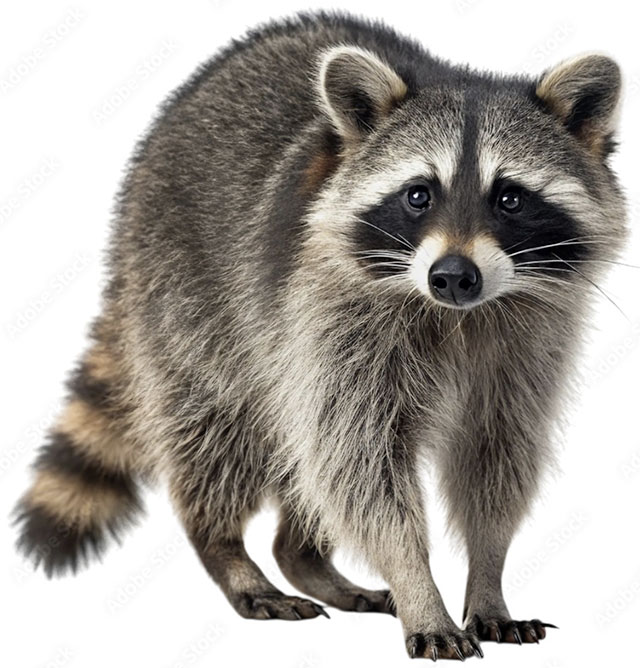 |
| Ringtail |
Bassariscus
astutus
The ringtail — aka Ringtail cat — is a member of the raccoon family. It is a small, reclusive, nocturnal mammal, with a tail that’s about the same length as its body. Total maximum length, nose to tail tip, is around 30”; average weight is about 2.5 pounds. It’s an agile climber, and can produce a variety of sounds. Its range is limited to the southwestern states and all of Mexico. It is an omnivore, eating live prey as well as fruit and seeds. They are said to make good pets and effective mousers. 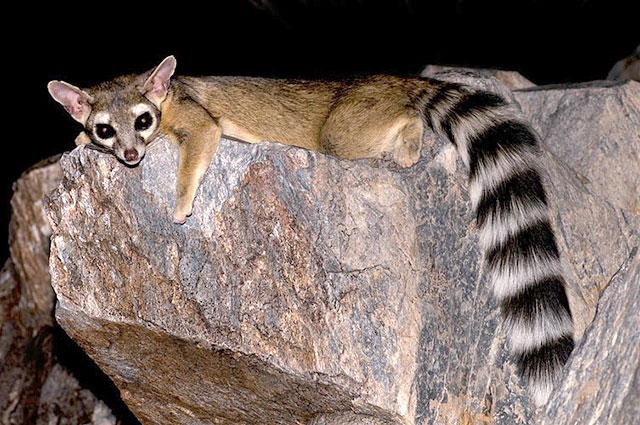 |
| Rock squirrel |
Otospermophilus
variegatus
Rock squirrels are native to Mexico and the southwestern United States, and are especially common in the Texas Hill Country. Their coloring is much darker and more mottled than tree squirrels. They are the largest members of the squirrel family (Sciuridae), measuring up to 21” in length. While they can climb trees, they are ground-dwellers, living in burrows which are often hidden by rocks. They are primarily herbivores, although they will occasionally eat insects and young vertebrates such as birds. They are active during the day and are very wary and skittish around humans. 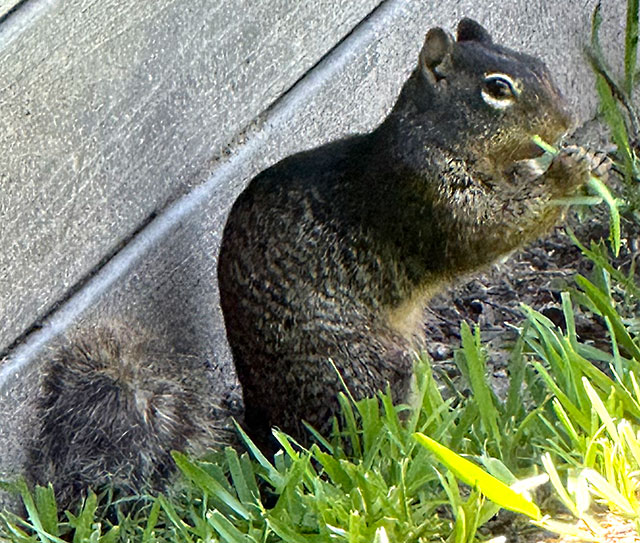 |
| Striped skunk |
Mephitis mephitis
The striped skunk is found in every state in the U.S. There are 13 recognized subspecies, and the one most likely to be found in Central Texas is the Texas long-tailed skunk (M. m. varians) which has a longer tail than most of the other subspecies. Skunks are omnivorous, and can grow to a length of up to 30″ and a weight of up to 10 pounds. Skunks can spray musk up to 15′ away, with mist spreading even farther. They have very few natural predators due to that defensive mechanism. Predatory birds such as owls and hawks are more successful than land-based predators in preying on skunks. Skunks are one of the major carriers of the rabies virus. 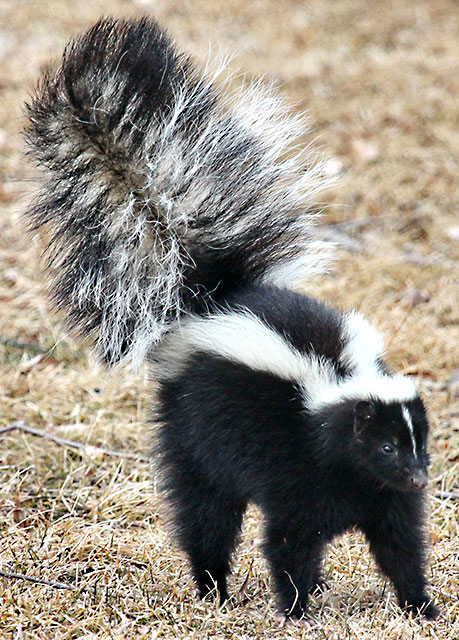 |
| Virginia opossum |
Didelphis
virginiana
While commonly referred to as “possum,” the species of Virginia opossum is distinct from the “true” possums found in Australia. Its range in the U.S. is primarily east of the Rockies, but with scattered populations along the west coast. They can be up to 22″ long (excluding the tail) and weigh up to 6 pounds. They are marsupials, have prehensile tails, opposable thumbs on their hind legs, and 50 teeth, more than any other North American mammal. They are omnivorous, eating almost anything they can catch, and though they are said to be major consumers of ticks, this has not been scientifically verified. They are resistant to snake venom and the rabies virus. 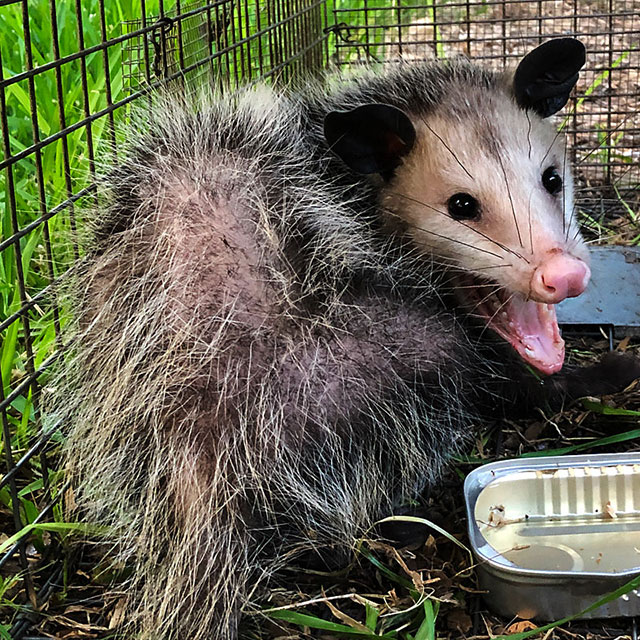 |
| White-tailed deer |
Odocoileus
virginianus
White-tailed deer are found throughout the U.S. although Texas is home to the largest population. There are 38 subspecies scattered throughout the western hemisphere; the Texas white-tail (O. v. texanus) is most common in Texas. There is a huge variance in the size of this species; males can range from 70 to more than 400 pounds. Deer have dichromatic vision, and can distinguish only two primary colors (blue and yellow), hence the use of red and orange clothing by hunters, making them difficult for deer to see. They are mostly herbivorous, but have been known to eat small birds, mice, and other small mammals. They are the primary hosts for the ticks that carry Lyme disease and are susceptible to chronic wasting disease. 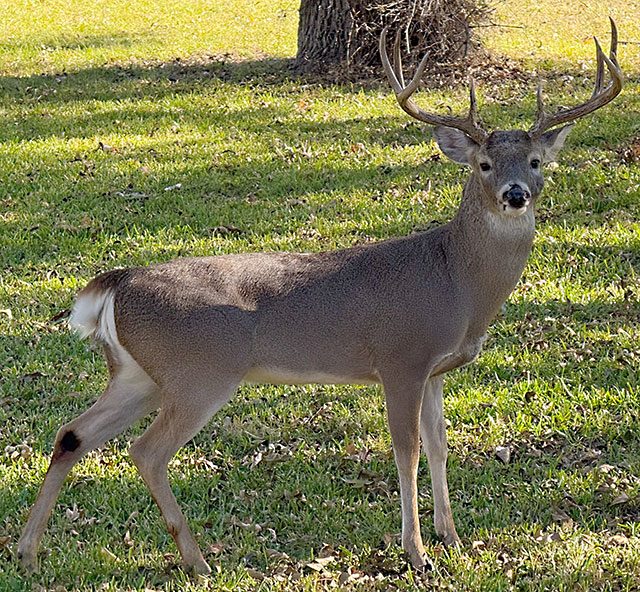 |
| Miscellaneous | |
| Common snapping turtle |
Chelydra serpentina
The range of this species extends from the east coast to the eastern edge of the Rockies, but does not include most of Texas, and especially not the Texas Hill Country. This specimen was obviously caught elsewhere and released into Pecan Creek, where we spotted it on the low water crossing in our neighborhood. It displayed a characteristic combative disposition when I attempted to coax it into the water and away from car traffic. The species does inhabit shallow ponds, as well as streams such as our creek. They are omnivorous, feeding on almost anything they can catch and swallow. However, despite their behavior on land, they are not aggressive toward humans in the water. 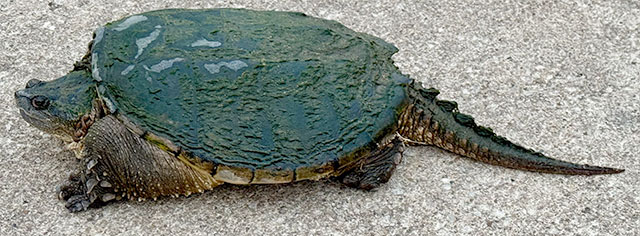 |
| Cope’s gray treefrog |
Dryophytes
chrysoscelis
This species is practically indistinguishable from the Gray treefrog (Dryophytes versicolor), as they are almost identical in appearance, habitat, and behavior, and they have some overlap in range. However, the Cope’s Gray is more likely to be found in Texas. They are found in wooded areas along creeks and rivers, and in urban areas in shrubs and trees. They feed on insects such as beetles, flies, crickets, caterpillars, and moths. They are small, 1-2 inches in length, and are gray, green, or brownish, and the insides of their hindlegs are bright yellow-orange in color. 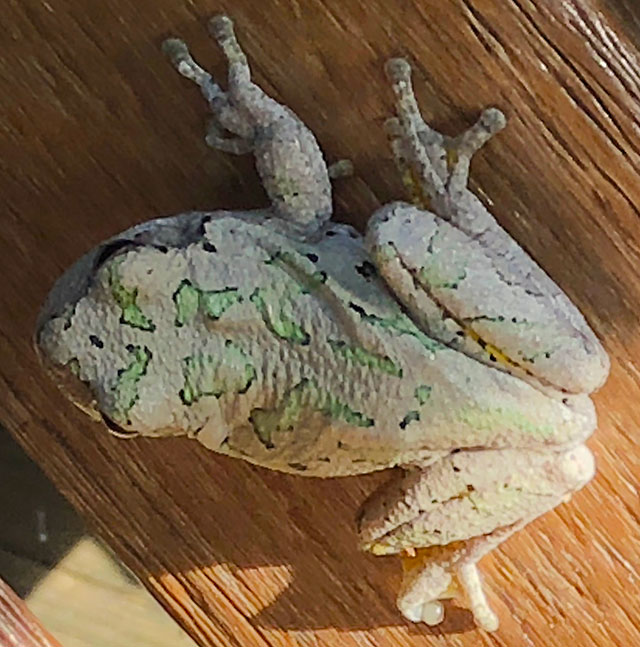 |
| Grass carp |
Ctenopharyngodon
idella
The grass carp is an invasive species of fish that was originally imported to the U.S. from Taiwan and Malaysia in 1963. The species was considered for use in controlling the growth of aquatic plants in lakes, ponds, and streams. Its presence has been recorded in 45 U.S. states. Its voracious appetite for aquatic plants destroys critical habitats for native fish and waterfowl, and it can introduce parasites and pathogens to native fish populations. On a local level, only one specimen was observed in Pecan Creek in 2024, and there’s no evidence that it has reproduced. The fish can grow to more than 6′ in length and weigh up to 100 pounds. 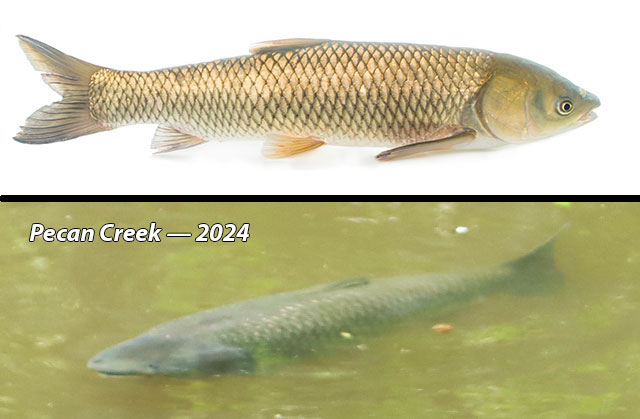 Bottom: Photo of fish in Pecan Creek, 2024. Photo credit: Mine |
| Texas redheaded centipede |
Scolopendra heros
idella
This is the largest centipede in North America, reaching a length of 8″ in the wild, and even longer in captivity. Despite its name, it has only 42 or 46 legs. Its range is throughout the southwestern US (and all of Texas), and northern Mexico. Its diet consists of invertebrates as well as small vertebrates such as rodents and reptiles. Its venom is one of the most complex of any creature, consisting of more than 500 components, and the centipede can adjust the mixture depending on whether it’s for defensive or offensive purposes. Its bite is quite painful for humans, but not deadly. 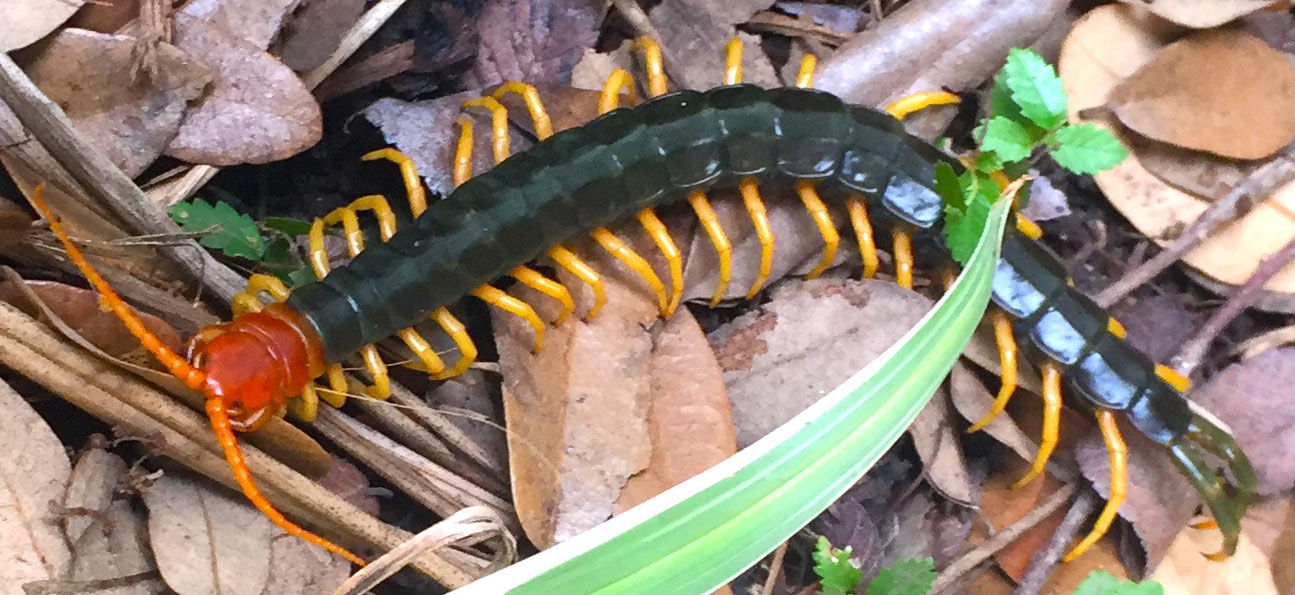 |
| Texas river cooter |
Pseudemys texana
idella
This freshwater turtle is endemic to several Texas rivers and their tributaries, including the Colorado River which feeds into Lake LBJ. The specimen in the photo was in Pecan Creek, which also feeds Lake LBJ. The turtle can grow to be more than 12″ long; males are smaller than females, but have longer tails and claws. The species is omnivorous, feeding on aquatic invertebrates and fish, as well as aquatic plants and algae. They are diurnal and very shy/skittish. 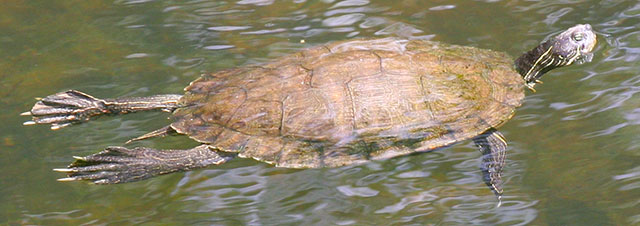 |

Footnotes
[0] Regarding those informational popups. I’ve always been a fan of the way Wikipedia uses them on links to provide a preview of the content being linked to. They provide a more meaningful preview than the brief text-only title attribute that can be coded into the link HTML. Unfortunately, my coding skills are nowhere nearly good enough to create this feature. Fortunately, ChatGPT’s coding skills are more than good enough. So, I entered into a discussion with it, and more than 2,000 words later, emerged with what you see here. I’m quite happy with how it works and looks, and I hope you like it as well, but it’s actually quite time-consuming to implement and I won’t be using it except in special cases like this post. [Return]
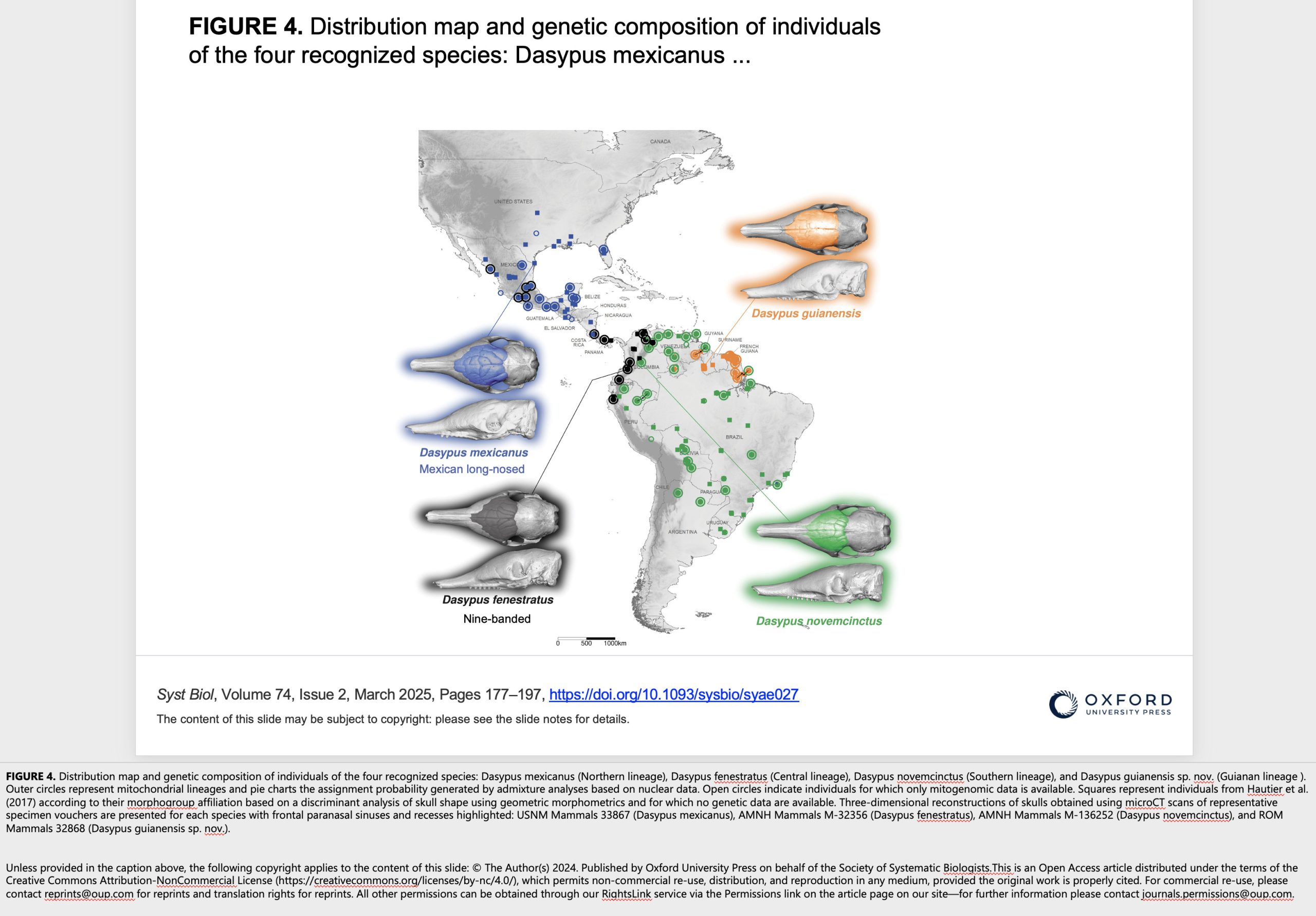
[1] In 1995, Texas designated the nine-banded armadillo as the official state small mammal. However, a detailed analysis — the results of which were published in 2024 — of genetic material from armadillos found in North, Central, and South America revealed that there are four distinct species of the animal, and the species found
in North America is actually the Mexican long-nosed armadillo. The
nine-banded armadillo is found exclusively in South America. This is a perfect example of the way genetic research can clarify and expand the taxonomy of life on Earth. A more accessible discussion of the implications of this discovery is found here.
The following graphic shows the distribution of the four new species identified by the above-described research. Click on the image to see a full-sized version that includes the slide notes.
[Return]
Discover more from The Fire Ant Gazette
Subscribe to get the latest posts sent to your email.
I loved every word of your educational article and clicked on each picture, even the snakes. Thank you for sharing. I’ll be able to identify the lizards now!
Good for you, Audrey! I’m glad you found it helpful. 🤗