
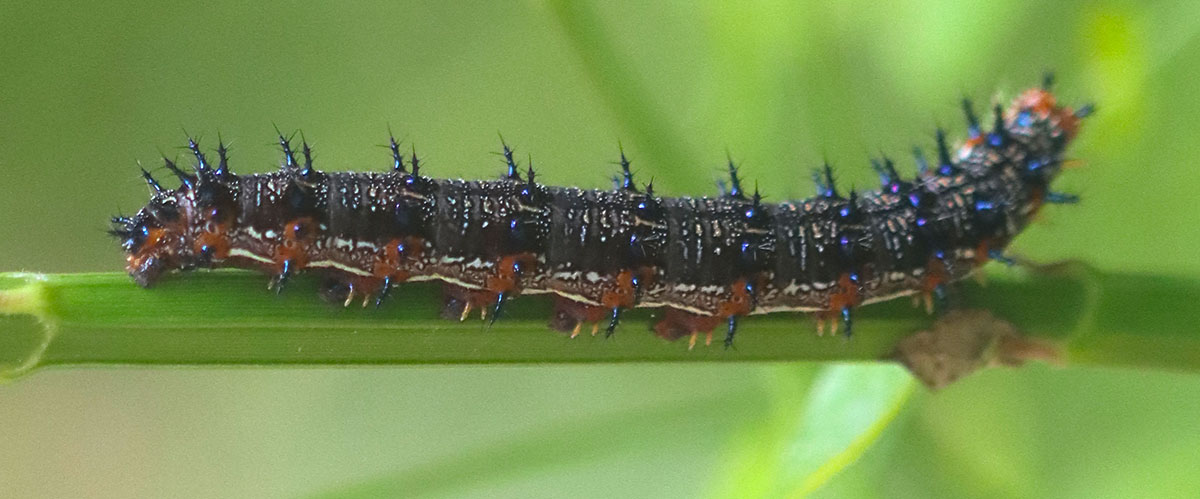
Howdy, y’all! Welcome another edition of Neighborhood Nature, wherein we explore the wild and wacky world just outside our windows (and, in this case, a half block down the street).
Debbie and I spotted a few things over the past week or so that seem to suggest the food chain subtitle, at least if you turn your head just right and look at them sideways and then use your imagination. But even if you don’t buy into the concept into which I’m attempting to shoehorn them, I hope you’ll be fascinated by them.
Oh, and way down at the bottom of this post, there will be photos and videos of snakes. You’ll have plenty of notice before they pop up on your screen; just scroll carefully and you’ll be fine.
OK, let’s get to it, shall we? The caterpillar in the header photo will eventually metamorphose into this beautiful critter:
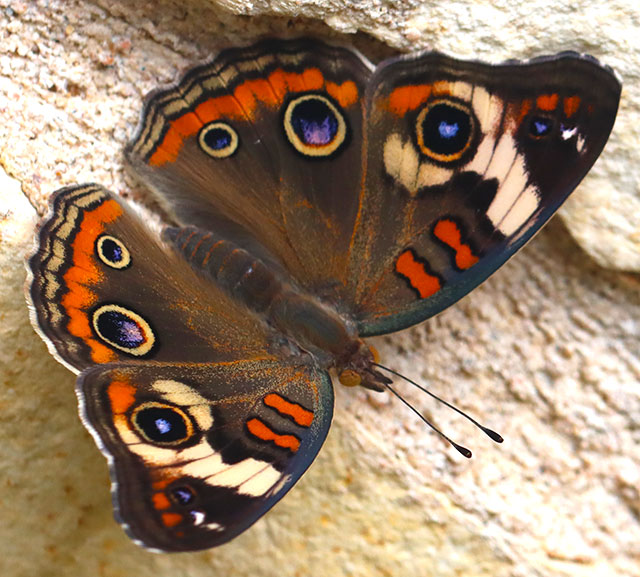
It’s sometimes referred to as a Common Buckeye butterfly, but I find nothing common about it, appearance-wise. But let’s not get ahead of ourselves; let’s backtrack to the most basic part of the food chain, at least where this post is concerned.
Take another look at the header photo. The caterpillar is stretched out on a denuded stem of one of the firecracker plants (we think it’s a Firecracker Fern [Russelia equisetiformis]) growing in the courtyard. We counted four of these caterpillars spread across multiple plants.
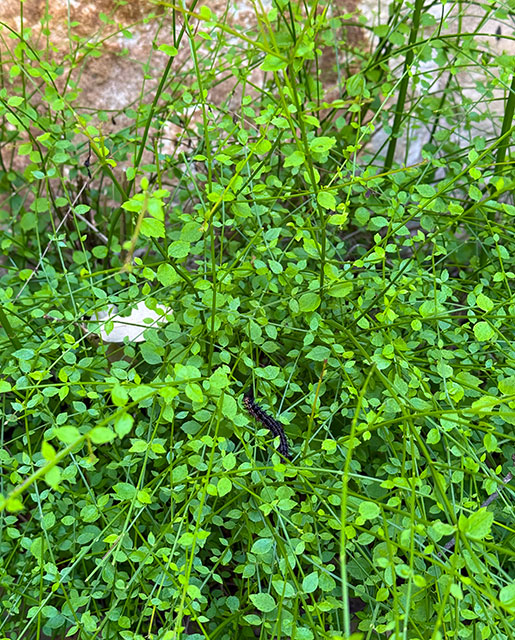
So, how did this flora flaying come about? I’m sure you can guess; following is a video to confirm your guess.
Note: I’ve sacrificed video quality to crop and enlarge the scene so as to make details of the action more obvious. I recommend watching in fullscreen mode (with the sound up; trust me on this).
Well, that’s the first course in our food chain review. Up next: the eater becomes the eatee.
This is our resident Texas spiny lizard (aka TSL), about whom I’ve written multiple times in the past (or, at least, about its kinfolk).
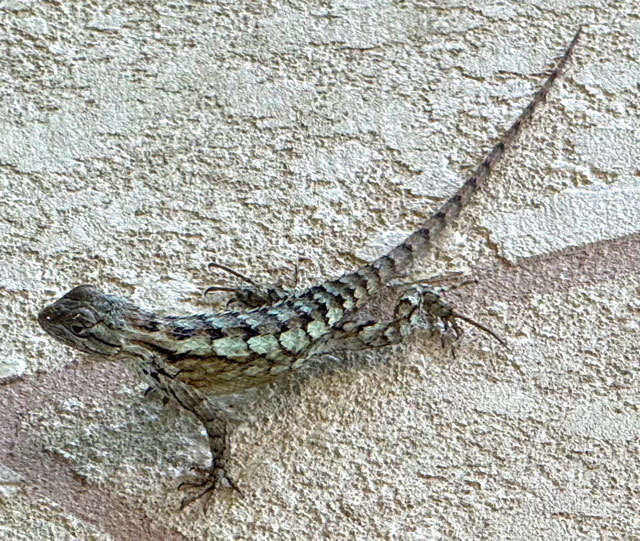
It appears on our back deck almost every morning, as soon as the sunlight hits the edge of the deck. It’s usual pose is one of, well, repose…soaking up the sunshine as it looks out over the back yard. But it will often scurry around on the shaded back porch looking for meals. I happened to look out the sliding glass door in time to see it succeed in that quest.

I was going to let the following video speak for itself, but after watching it again, I decided to issue something of a caveat. The video is a minute and 49 seconds of our lizard eating a caterpillar of unknown (to me) identity — although I can state authoritatively that it’s not our Buckeye butterfly caterpillar. While I appreciate the lizard’s help in keeping what are possibly destructive caterpillars under control — we’ve had significant problems with walnut caterpillars in the past — and I don’t judge nature’s food chain at the lower levels, I realize some readers might feel a bit squeamish at the sight. Use your own judgment before hitting “play.”
Let’s recap our progress. We’ve seen a caterpillar eating a plant, and a lizard eating a caterpillar, and so the logical next step is…well, what might eat a lizard?
Don’t worry; I’m not actually going to show an animal eating a lizard, but I will share a brief video of animals that will eat one, given the chance.
This is a compilation of footage captured on two consecutive nights by our security system camera. It shows a family — two adults and two kits — of gray foxes (Urocyon cinereoargenteus). We are regularly visited by foxes at night, and very occasionally during the day, but we’ve never had an entire family grace us with its presence.
Gray foxes are omnivores; they’ll eat pretty much anything they can catch. They prefer small mammals, and will even eat berries and nuts, but they won’t hesitate to make a lizard part of a well-balanced diet, which could put our TSL at risk. And while I think the lizard overnights in one of our pecan trees — we’ve watched it scurry up the tree trunk around dusk a couple of times — foxes are also excellent climbers, although I seriously doubt that a fox would climb a tree just to chase a lizard.
Update (6:59 a.m.) I guess I need to rename our place to something like the Fire Ant Cafe because an hour after posting this article, my eye caught a movement through our bedroom window. It didn’t look like a squirrel (our usual morning visitors), so I grabbed my phone and ran around to the dining room where I had a less obstructed view, and here’s what I saw:
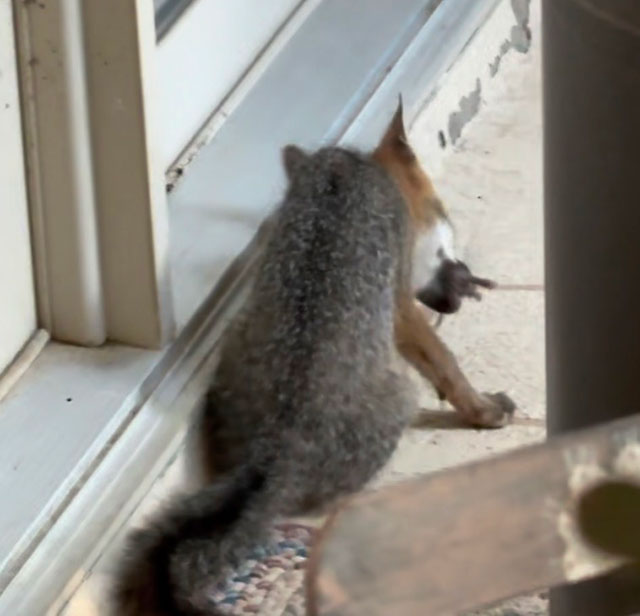
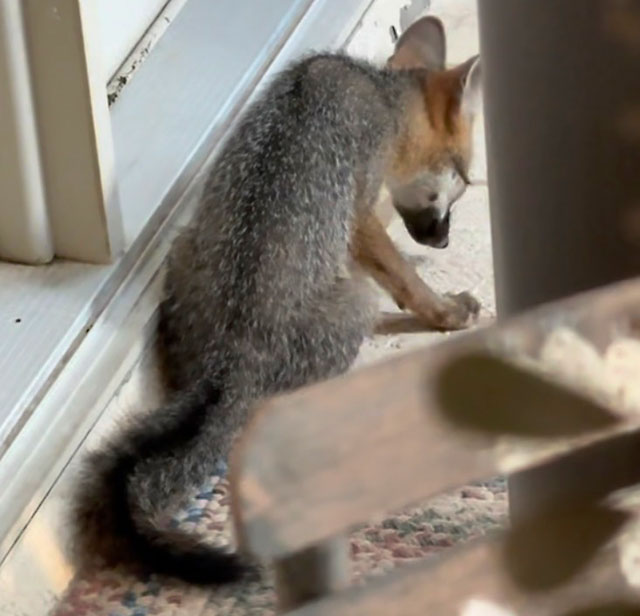
That’s one of the young foxes that were in the security cam video above, and it’s devouring a mouse. (This is a screen capture from the video of the meal; I’ll spare you that scene.) It finished its meal in less than 90 seconds and trotted back toward the creek. We later saw it and its brother or sister and one of the adults in the yard…again, an unusual sighting during daylight hours.
So, the food chain display continues to grow.
But you know what else a fox will eat? That’s right — a snake. And here’s your warning sign:

My usual morning routine includes a pre-workout stroll to the low water crossing, down the neighborhood’s walking trail for about a hundred yards, then back along the creek bank before returning to the house. I never know what I’ll see in or around the creek in the [relatively] early morning hours, and I always carry my phone with the camera app activated.
A couple of mornings ago, my diligence was rewarded by the sight of not one, but two harmless plain-bellied water snakes (Nerodia erythrogaster), the most common species of snake that is found around the creek.
The smaller snake — perhaps two feet in length — was attempting to hide in the rocks on the bank when I intruded on its presence. Had I not seen the movement, I would never have spotted the little guy, but once I did, I was determined to acquire some photographic evidence.
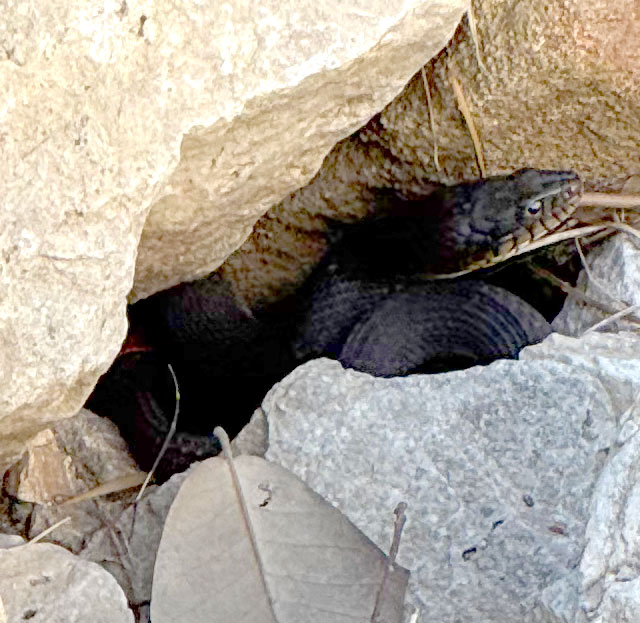
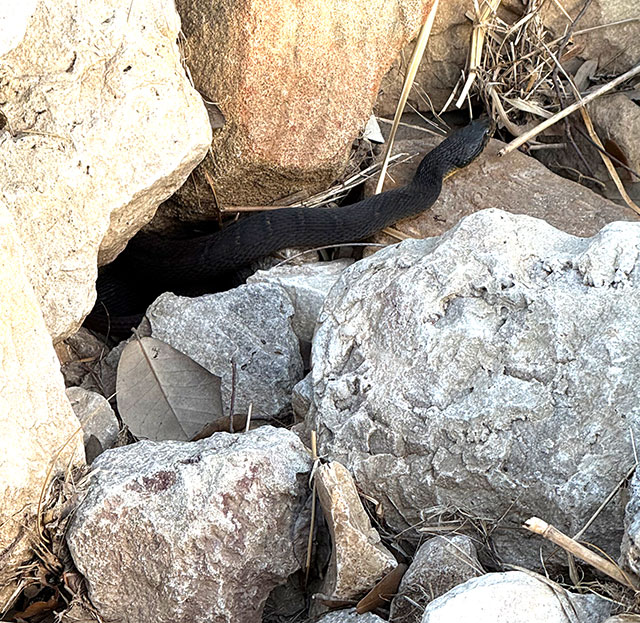
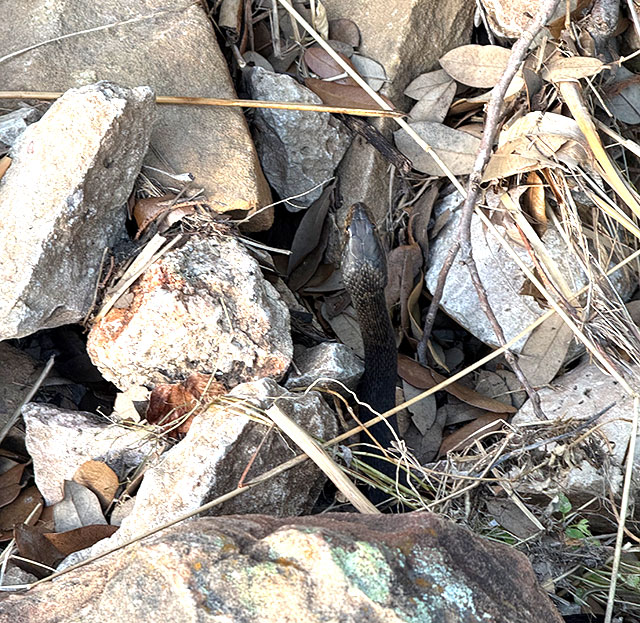
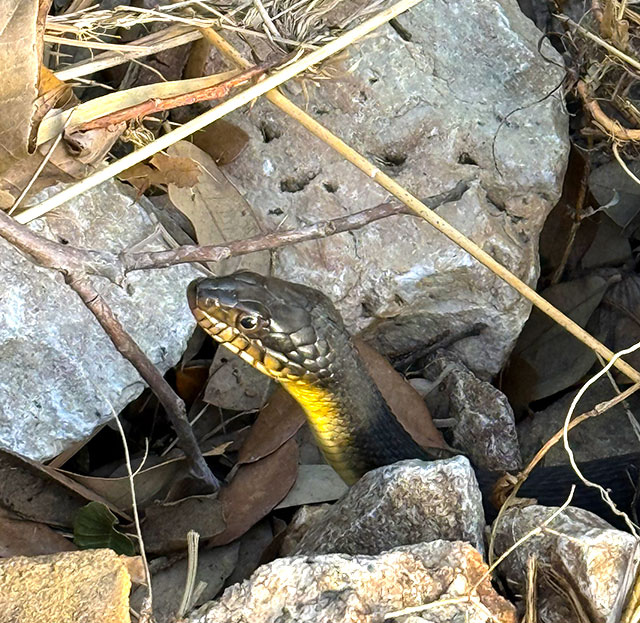
I think it’s a very pretty specimen of a young PBWS. (I almost referred to it as “a striking specimen,” but that would have been wildly inappropriate.)
The second snake was on the other side of the creek, on the downstream concrete apron for the low water crossing. It was in plain sight, and about twice the length of the first one.
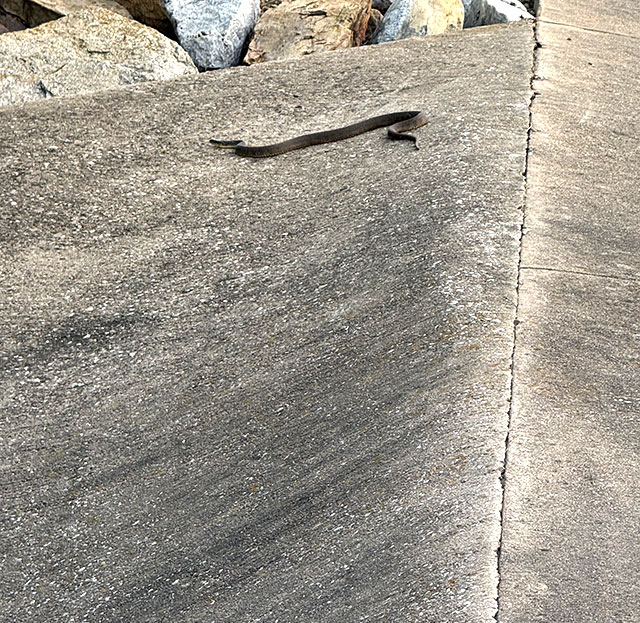
I suspect it was on its way back to the water, but my presence accelerated that process, as this video plainly illustrates:
I often wonder if snakes and turtles get something like a rope burn when they slide down the concrete. I’m sensitive that way.

That’s a wrap on this edition of NN. As always, I’m a bit awestruck by the goings-on provided by nature, despite the continuing encroachment of development that slowly eats aways at the habitat. But then, as I think we’ve established…eating is an integral part of nature. 😎
![Meme: What's he doing to the goat? [via Jurassic Park]](https://ericsiegmund.com/fireant/wp-content/uploads/2026/07/meme_whatshedoingtothegoat.jpg)
Discover more from The Fire Ant Gazette
Subscribe to get the latest posts sent to your email.