
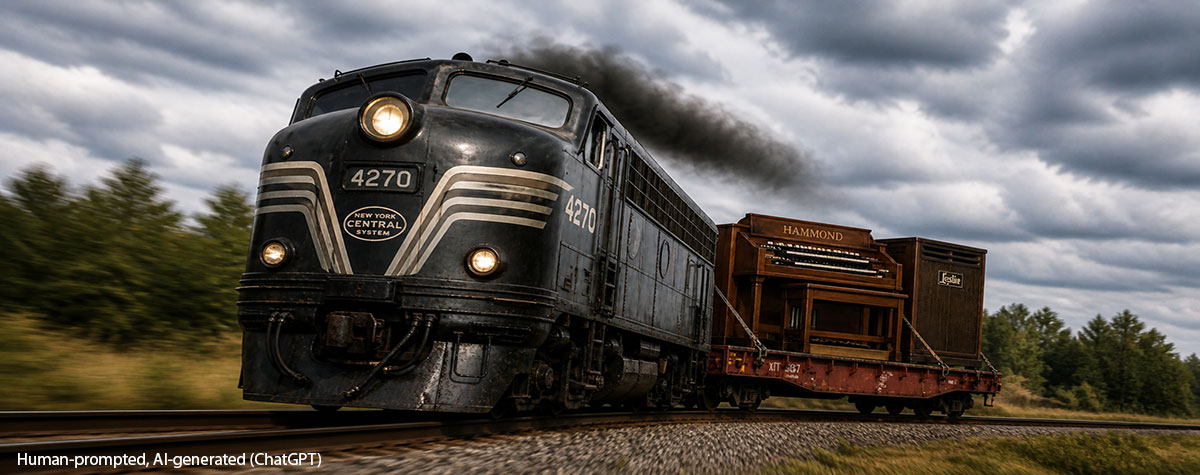
There have been many well-known couples in the entertainment business that have brought joy to audiences. Some familiar names include Gilbert & Sullivan, Abbott & Costello, Martin & Lewis, Astaire & Rogers, Gibson & Glover, Clapton & Stratocaster, Lennon & McCartney.
I suspect that most of you recognize most of those names, and may even be devoted fans of their work. But I wonder whether any of you are fans of the duo of Hammond & Leslie?
How about a little music trivia challenge to kick things off? Listen to this short snippet and tell me the name of the song and/or the band to which it owes its existence.
I’ve no doubt that you recognized that as Jon Lord’s introduction to Lazy, from Deep Purple’s Machine Head album, released in 1972 [1]. It’s not just a great rock song, it’s also a prime example of the distinctive sounds that the combination of a Hammond organ and Leslie speakers can produce.
I wouldn’t go so far as to say it’s a match made in heaven, unless we’re thinking of a rock and roll heaven [2]. But there’s some pretty interesting technology at work that’s worth exploring a bit.
But first, some history…
The Hammond Organ makes the scene
In 1934, a man named Laurens Hammond (1895-1973) filed a patent for an “electrical musical instrument.” He, along with other inventors of the time, was interested in the idea of electronically reproducing the sound of a traditional pipe organ. His patent caught the eye of none other than Henry Ford, and Ford’s enthusiasm for the idea was the stimulus that Hammond needed to forge ahead and produce what became known as the Hammond Organ.
It proved to be an immediate success and soon appeared first in churches and concert halls, and then in recording studios and more modest music venues across the country.
By itself, the Hammond Organ was a versatile and popular instrument, but the appearance of another new invention took its popularity to a significant new level. That invention was the Leslie speaker.
Along comes Leslie
In the late 1930s, another inventor, Donald Leslie (1911-2004), began working on a device to allow a small instrument (like a Hammond organ) to emulate the distinctive tones of a traditional pipe organ. Those tones benefit from the spatial variation in the sound due to several factors, including the relatively wide distance between the various pipes. (If you really want to get lost in the science behind pipe organ music, knock yourself out.)
Leslie found the Hammond to be lacking in that area, and he had an idea for a solution…and it centered around a well-known phenomenon known as the Doppler Effect, first described in 1842 by a scientist named — wait for it — Christian Doppler (1803-1853). Since the Doppler Effect in sound arises when the source of that sound is moving toward or away from a stationary listener, Leslie came up with the idea of using rotating speakers to emulate the effect.
In 1962, he patented his “Rotary Electrostatic Speaker.” As you may be able to discern from the illustration below, taken from the original patent filing, his contraption (which is unchanged in principle today) is actually comprised of two speakers, both of which can be rotated independently from each other via separate mechanisms.
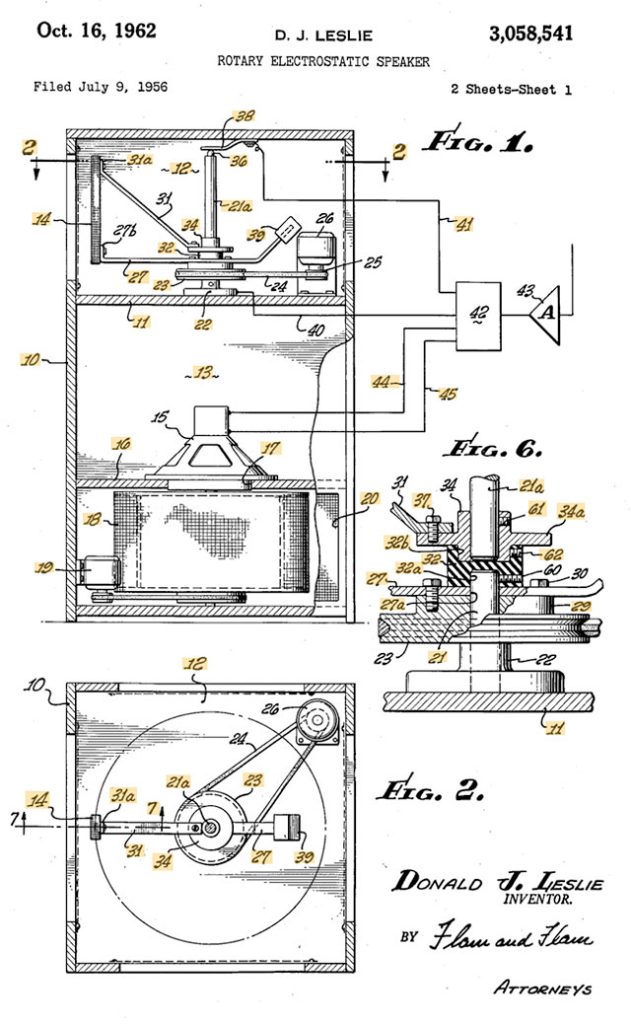
The mechanics of the speaker are simple in concept. Within the wooden cabinet, there’s a built-in amplifier (it was a 40-watt tube amplifier — aka valve amplifier — in the early models) that connects to and receives the audio output from the instrument (e.g. organ, guitar, etc.). The audio signal is then passed to a passive crossover which splits the audio into high and low frequencies. The traditional crossover frequency setting for the Leslie is 800 Hz (for you musicians, this frequency approximates a G# in the fifth octave, a high-pitched note in the upper midrange of a flute; middle C on a piano is 261.6 Hz). Frequencies above 800 Hz are sent to the treble unit (aka tweeter) at the top of the cabinet, and those below that frequency are sent to the big speaker (aka woofer) at the bottom of the enclosure. [3]
Now comes the magic parts. If you view a cutaway of the Leslie speaker in operation, you might think that the tweeter and the woofer are rotating. After all, it was called a rotary speaker. But that’s not what’s happening. In reality, the tweeter is stationary but is connected to a pair of rotating horns (only one of which is active; the other, positioned directly opposite, simply acts as a counterbalance), and the rotating horn provides the vibrato and tremolo effects for the upper range. Down below, the woofer is also stationary, but it’s sending its sound into a rotating baffle (aka drum), usually comprised of a foam material and which provides the same effects for the lower frequencies. In addition, the speaker cabinet itself has ports in different places, giving the sounds additional spatial variation.
Sound confusing? Here’s a gif of an operating Leslie that will clear things up.
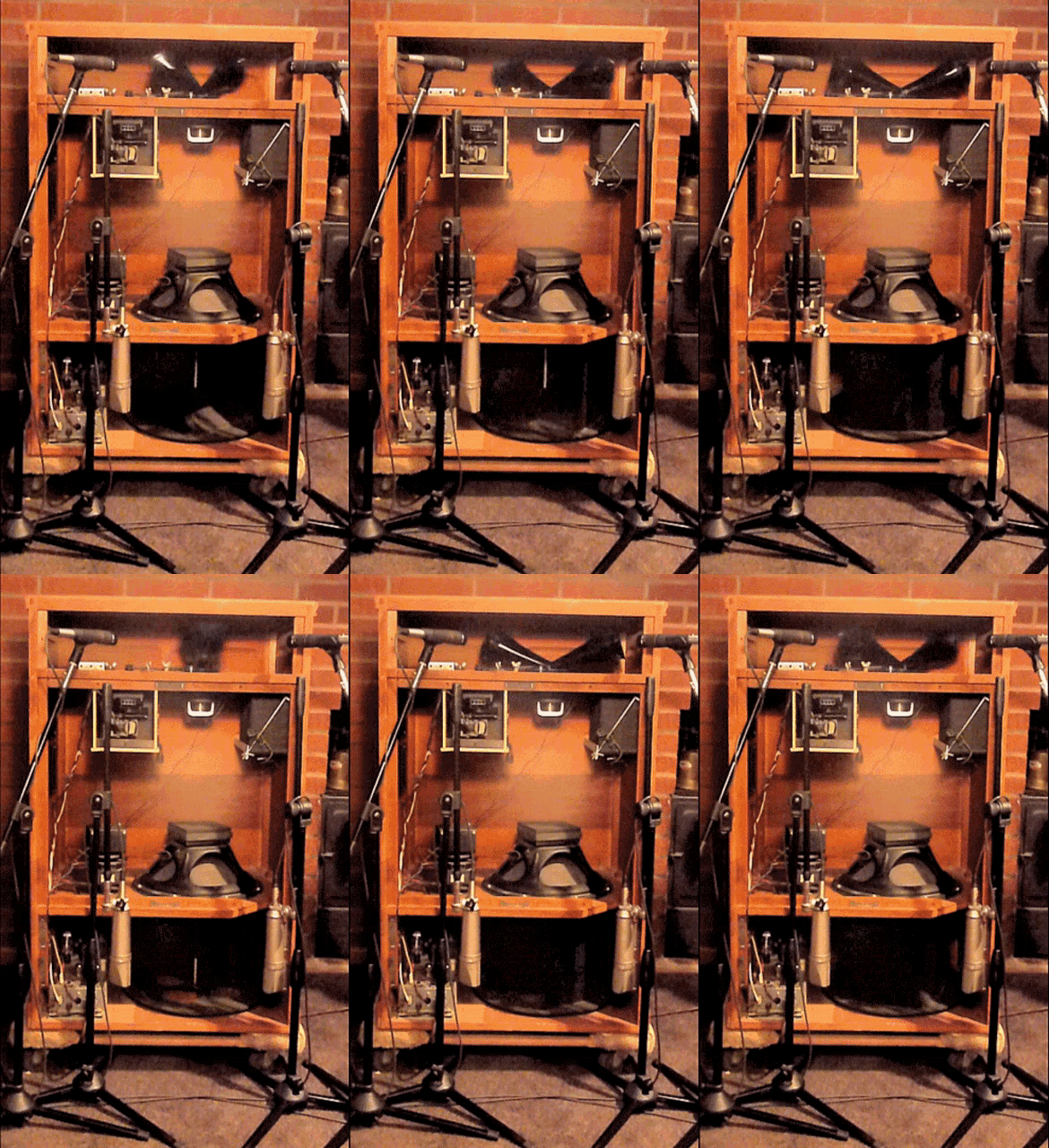
As I mentioned above, the Leslie speaker’s sound effects are a combination of vibrato (a change in pitch) and tremolo (a change in volume), both of which are the result of the Doppler Effect produced by the spinning components. [4]
Now: The sum of the parts…
We know that Donald Leslie designed his speaker system specifically for the Hammond organ, but when he pitched a partnership proposal to Laurens Hammond, he was immediately rebuffed. It’s reported that Hammond hated the idea, and in fact Hammond dealers were not allowed to sell Leslie speakers. He even redesigned the output port for his organs to be incompatible with the Leslie’s connectors. Of course, this was a losing strategy of whack-a-mole, as Leslie simply redesigned his connectors.
In any event, the combination of the two was irresistible to musicians, and the market overruled Hammond. And today, the Hammond Organ Company (now owned by the giant Suzuki Musical Instrument Corporation) advertises Leslie products on its website.
The musicians who employ Hammond organs, often in conjunction with Leslie speakers, make up a literal Who’s Who of the pop, rock, jazz, and blues genres. Check out this list on Wikipedia of mostly well-known musicians who play or played Hammonds, and this YouTube playlist of selected performances using Leslie speakers. By the way, Leslies are not used solely with organs; there’s a specific model made for guitars, and other musicians have used them with pianos [5a] — and even drums [5b].
One last thing…
We kicked off this marathon — I’m shocked and delighted that you’re still here! — with a sampling of music from Deep Purple, and I’d like to end it with another familiar example of Hammond/Leslie product. A Whiter Shade of Pale is perhaps Procol Harum’s most famous recording. It was recorded and released in 1967 and has since been covered by more than a thousand other artists.
I include the song here due to its relevance to the main subjects of the post, but I’m also intrigured by the classical influences in the song. [6]
Matthew Fisher, the band’s organist (the band also feature a pianist) played a Hammond organ coupled with a Leslie speaker, and the combination is a bit less, well, frantic than that found on the Deep Purple track we started with. Here’s a remastered video of the band’s performance.
One more last thing…
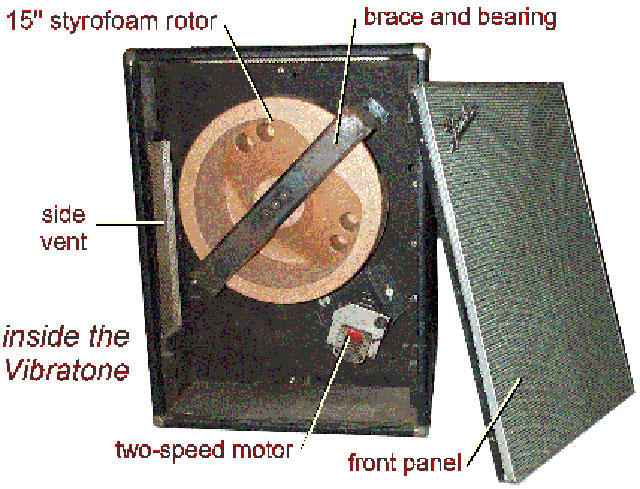
As one would expect, the sound and even the mechanisms of the Leslie speaker have been copied, both physically (see, especially, the single-speaker Fender Vibratone (see below), used by semi-famous musicians like The Beatles and Stevie Ray Vaughan) and electronically (most frequently in the form of pedals for electric guitar use, but also built in to electronic keyboards, such as those produced by Nord and Yamaha). The popularity of these emulators is evidence that Donald Leslie’s concept was indeed a musical breakthrough of epic proportions.

Footnotes
[1] The rock cognoscenti among you — and I don’t mean geologists although you might be in both categories — will recall that Machine Head also introduced Deep Purple’s arguably most famous song, Smoke On The Water, which derived its title and lyrics from the fire that destroyed the Montreaux (Switzerland) Casino. The fire started during a concert featuring Frank Zappa and The Mothers of Invention. Deep Purple was to record an album at the Casino the following day; they ended up scrambling to find an alternate venue in which to record…but their efforts resulted in their biggest commercial success, both for the album and the song. [Return]
[2] As far as I can discern, the Righteous Brothers did not use a Hammond organ or a Leslie speaker for their recording of Rock and Roll Heaven. I apologize if I’ve somehow misled you. [Return]
[3] As I was composing this article, I hadn’t planned to spend any additional time on what I considered to be a minor character in the story, but I soon realized that the crossover is actually a major component in the Leslie’s unique sound. The 800 Mz crossover frequency is misleading, as the design of the Leslie’s crossover module provides a more subtle transition from low to high than it implies. I learned from this video (well worth watching if you’re into such sound-related esoterica) that the actual frequencies that may be reproduced by the horn (treble) go down to 400 Hz, while those which the woofer reproduces can go up to 1600 Hz. This allows a nice blending/overlap of frequencies; the preceding video demonstrates this quite clearly. [Return]
[4] This was another learning opportunity for me, as I had never thought about the difference between vibrato and tremolo. It’s interesting (to me, anyway) that guitarists sometimes confuse the two terms, and the guitar manufacturer Fender exacerbates the situation by calling the “whammy bar” on the Stratocaster a “tremolo arm,” when in fact it creates a vibrato effect. Not only that, but on some guitar amplifiers, the vibrato setting actually produces tremolo.
Here’s an excellent video explaining the difference between the two effects. It’s guitar-centric, but the underlying principles apply here as well.
[Return]
[5a] It seems that pretty much any instrument with an output jack or connector can be hooked up to a Leslie cabinet. It’s not necessarily a straightforward interface, as the following video shows, but essentially it involves a preamplifier (aka preamp) that boosts the audio from the instrument, thus protecting the sound from distortion or distracting noise artifacts. In addition, the connecting device might also contain controls to vary the speakers’ volume and/or the speed of the rotation of the speakers.
[Return]
[5b] Those of you of a certain, um, vintage are intimately familiar with In-A-Gadda-Da-Vida, Iron Butterfly’s 1968, 17-minute-long recording. It features Ron Bushy’s lengthy drum solo — I suspect it’s the world’s best known drum solo, perhaps rivaled only by the one in Wipeout and Ringo Starr was a fan, paying tribute to it on The End [Abbey Road] — and I was today years old when I learned that the solo was possibly routed through a Leslie speaker (I assume via microphones). Note, however, that the veracity of this claim is debatable.
If you google Did Ron Bushy use a Leslie speaker on In-A-Gadda-Da-Vida?, you’ll get an AI-definite “yes” in response. But according to this article about the actual process involved in recording the song, the answer is “no.” Here’s a quote from none other than the drummer himself:
Bushy relates his recollection of the primitive effect used during the drum solo: “The way they got the sound was they wired the speakers out of phase and then panned back and forth. That’s how they explained it to me.”
Of course, the brand of the speakers was not mentioned; I suppose they could have been Leslies. We may never know. Bushy died of esophageal cancer in 2021.
The video below focuses on the solo, but near the end, the band’s organist, Doug Ingle, eases into a duet with the drums, and his Vox Continental organ sounds as though it’s paired with a Leslie…but your guess is as good as mine, i.e. who knows? It still sounds cool.
[Return]
[6] In what is possibly a way-too-detailed look at a recording, this account on Procol Harum’s website mentions that the tune’s classical influence in the form of Bach’s Suite Number 3 in D Major Air On The G String. If you listen to the performance of that piece below and compare it to A Whiter Shade of Pale, you’ll probably be able to pick out the brief reference (hint: pay closer attention starting at around 30 seconds into the video). Interestingly, in this quote via the Wikipedia page for the latter song, the guy who composed the tune said this about the influence:
If you trace the chordal element, it does a bar or two of Bach’s ‘Air on a G String’ before it veers off. That spark was all it took. I wasn’t consciously combining rock with classical, it’s just that Bach’s music was in me.
But the tune isn’t the only aspect that had a classical influence. The song’s lyrics include this verse (emphasis mine):
And so it was that later
As the miller told his tale
That her face, at first just ghostly
Turned a whiter shade of pale
That line is a rather obvious reference to Geoffrey Chaucer’s The Miller’s Tale, which appears as the second story in Chaucer’s anthology, The Canterbury Tales, published in the late 14th century. Here again, the influence seems to be more subconscious rather than intentional.
The lyricist, Keith Reid, said:
I’d never read The Miller’s Tale in my life. Maybe that’s something that I knew subconsciously, but it certainly wasn’t a conscious idea for me to quote from Chaucer, no way.”
How does any of this relate to our Hammond/Leslie agenda? Well, not in any way at all, but here at the Gazette, we’re always looking past the obvious and dwelling on the irrelevant. No need to thank us; that’s just how we roll. [Return]
Discover more from The Fire Ant Gazette
Subscribe to get the latest posts sent to your email.
Eric, I don’t always take time to read these, but I love it when I do. I hope to go back & listen to the linked music.
“… here at the Gazette, we’re always looking past the obvious and dwelling on the irrelevant. No need to thank us; that’s just how we roll.”
Thank you anyway!!!
No, thank YOU, Pat! 😄 I know you have better things to do, so I always appreciate it when you drop in, and especially when you say nice things. 🤣
Very nice article, and thanks for the details. I remember being fascinated by the visible rotation of the Leslies at many concerts but didn’t know much about the specifics.
You’re welcome; glad you found some of it interesting. I had never seen a Leslie in action — just heard the results — so the whole topic was a revelation to me.