
[Editor: The following has been posted in defiance of the Gazette’s longstanding policy against publishing anything that even sniffs of being scientific geekiness. I wash my hands — figuratively speaking, of course — of the whole thing. Proceed at your own risk.]
[Me: 🥱]

I was thinking about sunrises the other day, and specifically about how the exact time of sunrise is determined for our location in the Texas Hill Country.
We have 45 windows in our house and almost a third of them have automatic shades that can be programmed to open and close at designated times [1]. Some of them are programmed to open and close at specific times (e.g. open at 8:00 a.m. and close at 8:00 p.m.), while others are set to open at 15 minutes before sunrise and others at sunrise, with corresponding sundown settings.
But we have some fairly significant hills to our east and so the sun doesn’t actually come into view until some time after the “official” sunrise. I can also remember vacations in the Rocky Mountains where that phenomenon was even more extreme. It all led me to wonder how those “official” sunrise times are determined, and I set out to understand how it works.
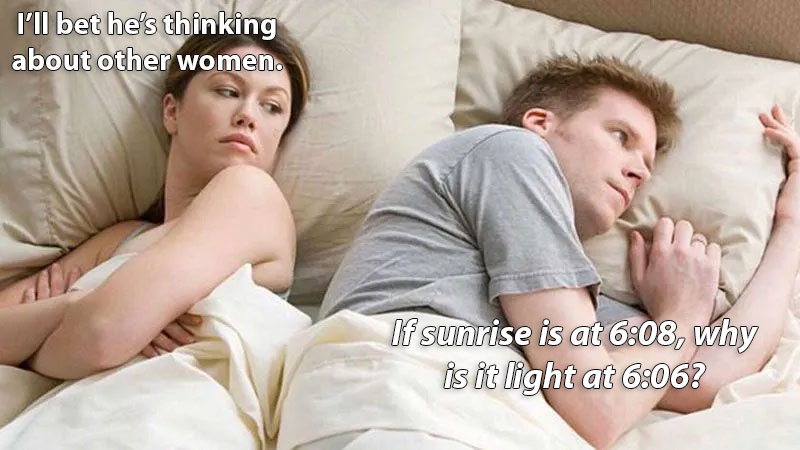
Unfortunately, I immediately ran into an insurmountable issue: the answer involves math…trigonometry, to be more specific, and spherical trigonometry, to be tragically specific. I have no idea what spherical trigonometry is, except that it may or may not involve computing the dimensions of a bowling ball or Charlie Brown’s head. You can read the above-linked Wikipedia article if you find my explanation a bit lacking in clarity or intelligence. [2]
Then there’s another obscure component called an analemma. Analemma is an astronomical term for a diagram that shows the position of the sun in the sky over a year, as viewed from a fixed position on earth. It takes the shape of a stretched-out figure eight. [3]
There are other components to the computations, most of which are as easily decipherable as ancient Egyptian hieroglyphs viewed through beer goggles, including (but not limited to):
- the Sun’s declination angle;
- the Equation of Time;
- Solar Mean Anomaly/Solar True Longitude;
- Atmospheric Refraction;
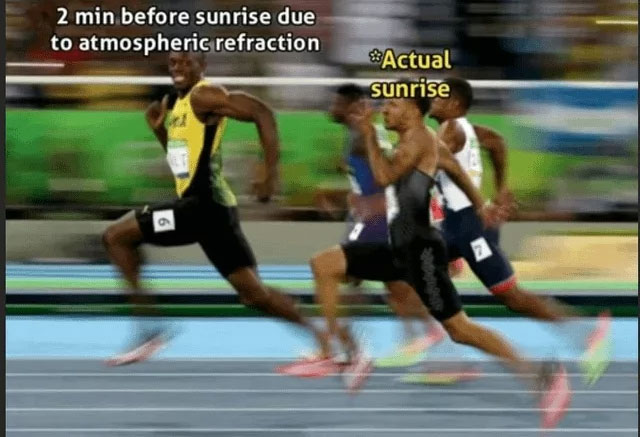
- Solar Radius — This one merits a bit of explanation. The solar radius helps define the upper limb of the sun, which is essentially the edge of the sun that first comes into view at sunrise, and that’s the exact point that determines sunrise (not when the entire or even middle point of the sun is visible). Now, because of atmospheric refraction, the sun’s light is “bent” a bit so that the upper limb seems to appear about two minutes earlier than the actual appearance. (It also causes the light from the setting sun to last about two minutes longer than the actual sunset, but let’s not go there, shall we?)
There’s still more to the computations, like hour angle, standard zenith angle, elevation of observer, and, of course, the latitude and longitude of the observer’s location. All of this is commingled into a boiling cauldron of science and math and astronomy and physics, with a smidgen of chalk dust and the charred remains of an old slide rule, and the precise time of your sunrise can be ladled out and ingested as part of a hearty breakfast. And you have my sincerest apologies for that awkward metaphor.
If all of this is as deeply mystifying to you as it is to me, the following video may or may not help with your understanding. (For me, it did serve to enhance my lack of understanding; YMMV.)
Regardless of whether or not we understand or care about what goes into sunrise sausage (another sad metaphor), the main takeaway is that for all intention purposes (sic), the time of sunrise for any given location on earth assumes that our planet is devoid of varying terrain — picture it as a massive, slightly tilted and tipsy semi-deflated basketball (ignore for this purpose ChatGPT’s analogy of earth as a spinning top; you did read all the footnotes, didn’t you?) — so that the official time of the sun’s appearance over hills, dales (whatever those are) [6], mountains, buildings, trees, Mesoamerican pyramids, and French basketball players is unaffected by such visual obstacles. In other words, just because you can’t see the sun from where you are doesn’t mean it hasn’t risen, unless the reason you can’t see it is because it’s nighttime.
By the way, if any of you are helioligists, astronomers, physicists, horologists, mathematicians, NASA scientists, really smart people like Ken Jennings, or, heaven help us, an AI agent, and you spot some errors or misperceptions in this post, please feel free to keep them to yourself, as I’m pretty much over this topic. Oh, and that goes for you grammarians, too. Thanks.
Footnotes of Dubious Usefulness
[1] I realize that automatic shades might sound fancy, but almost all new home construction around here includes wiring to accommodate those shades. Ours are battery-operated…very old school. But we did upgrade — at quite an upgraded price, I might add — to rechargeable batteries. Actually, with each shade requiring 12 AA akaline batteries, the payout for switching was pretty quick. [Return]
[2] OK, believe it or not, I was once pretty good at trigonometry, and by once I mean xx decades ago in Mrs. Hayter’s math class in Fort Stockton High School (go Panthers). In one of her required projects, we had to visualize an object, and then formulate the equations that would result in a drawing of said object. I did a locomotive (although it was simple and basic enough to be referred to as a choo-choo train). And having said that, I now realize that it was geometry and not trigonometry and I actually know nothing about trigonometry. And the more I think about it, the less I care. [Return]
[3] If the term analemma seems familiar to you, you’re either very smart (and I have no doubt that that is the case), or you’ve visited the Horseshoe Bay Nature Park and noticed — and perhaps even stood on — the analemmatic sundial that was installed by Boy Scout troop 284 in Marble Falls, Texas. This sundial uses your own body as the gnomon, which is the hifalutin’ term for the part of the sundial that casts the shadow. (The less fancy term is style.)
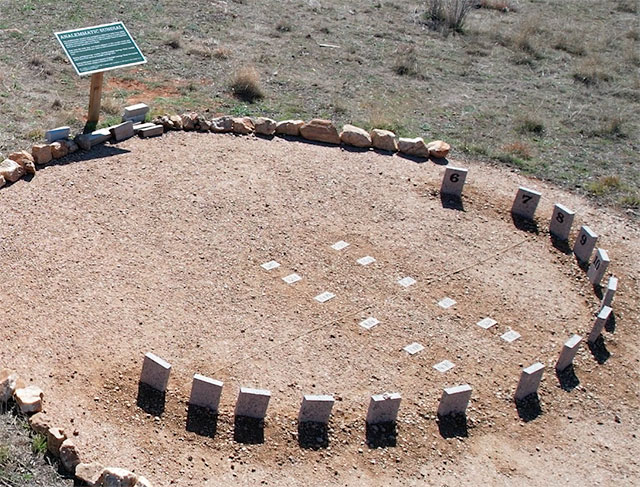
Here’s how it works. Each of the twelve stones lying flat on the ground in the center of the installation is inscribed with the name of a month. Those that are standing upright are numbered consecutively, corresponding to the time of day. In this case, they begin with 6 (6:00 a.m.) and end with 8 (8:00 p.m.). By standing on or next to the stone with the current month, your body (or upraised arm) will cast a shadow that will fall on or near the current time of day. Probably not quite as accurate as your Apple watch, and a bit less portable, but still pretty interesting, huh?
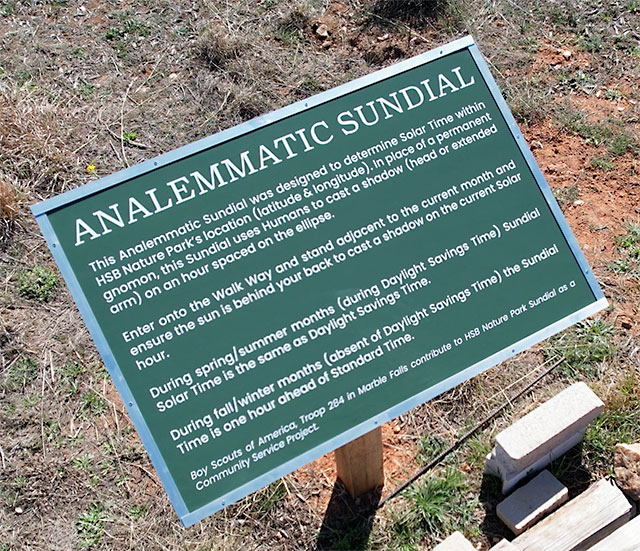
By the way, the number of upright stones will vary depending the the geographic location of the sundial, because the maximum number of daylight hours also varies with location. In our location in Texas, and according to this website, sunrise is never earlier than around 6:30 a.m., and the latest sunset is around 8:40 p.m. [4] Using this sundial means that you’re on your own to figure out what time it is when it’s later than 8:00 p.m. But you’re not dealing with the atomic clock here, you know.
There’s a website called sundials.org that will tell you more about sundials than you ever really wanted to know. The page on analemmatic sundials gets especially deep into the weeds; I give it props for employing the phrase nihil sub sole novi without bothering to translate it (I’m sure you won’t have to google its meaning, as I did…but see how considerate I am, just in case).
[Return]
[4] I would have guessed that the earliest sunrise and the latest sunset would fall on the summer solstice, or the longest day of the year. I would have been wrong, because they don’t. The summer solstice in Texas generally occurs on June 20th or 21st but it can be as late as June 22nd. [5] The actual latest sunset in Horseshoe Bay in 2026 occurs on June 30th and 31st, while the earliest sunrise happens on June 11th and 12th. [Return]
[5] I’m sure you’re now dying to know why the summer solstice doesn’t fall on the exact same date every year. Well, I’ll tell you…more or less. In order to simplify the explanation so that even I could understand it, I asked ChatGPT to compose that explanation, and below is an excerpt from the conversation it and I shared. But first, keep this fact in mind for the underlying context: Earth actually takes about 365.2422 days to orbit the Sun, while our calendar assumes that it’s only 365 days, and so we have a “leap year” to make up for the difference that eventually becomes significant. Now…from ChatGPT:
Every June, Earth shows up for its annual appointment with the Sun—the moment when it tilts just right and gives us the longest day of the year. You might expect that appointment to be penciled in neatly on the same date forever. But Earth, it turns out, is a bit like a kid’s spinning top: it doesn’t just spin, it wobbles.
Now, before we blame the wobble for everything, let’s be fair. The real troublemaker is that Earth takes about 365 days and a quarter-turn to circle the Sun, while our calendar insists on pretending the trip takes exactly 365. That leftover fraction nudges the timing of the solstice a little later each year, until we step in with a leap year and shove things back into place.
The wobble—slow, subtle, and taking thousands of years to amount to much—adds just a whisper of long-term drift. It’s there, doing its quiet work in the background, but it’s not the reason your calendar can’t make up its mind between June 20 and June 21.
So if you’re looking for a simple picture, think of Earth as a slightly wobbly top circling the Sun, trying to hit the same “just right” tilt each lap…while running a schedule that’s always off by a few hours. It gets there every year—but never at quite the same moment. [Return]
[6] A dale is a specific kind of valley, normally associated with northern English and Scottish landscape. It’s considered a more poetic term than the bourgeoisie-ish modern English version. If you really want to go down this rabbit trail, we can discuss related terms such as dell and vale, but I don’t recommend doing so. [Return]
Discover more from The Fire Ant Gazette
Subscribe to get the latest posts sent to your email.