

Introduction
Alert Gazette readers might recall that a few months ago, I mentioned a book entitled Noticing, by Richard Louv. The book is a collection of the author’s observations and thoughts about the natural world, and while it held my interest rather unevenly, his brief mention of a phenomenon known as ultra-weak photon emission (UPE) captured my imagination. UPE is a natural byproduct of living creatures’ metabolism, and it basically means that we (and virtually all metabolically active organisms) generate a detectable glow, albeit not one that our unaided eyes can perceive.
My curiosity about the phenomena by which living organisms generate light led me to research and write about them and I had every intention of covering them in a single post. However, as usual, I got carried away and when I had spewed out almost a thousand words and gotten only a third of the way through the overall topic, I realized it should be a multi-part series.
So, without further ado, here’s Part One of Three. [There will eventually be links to Parts Two and Three at the end, assuming I don’t flame out before finishing.]
Bioluminescence: Shine little glowworm, glimmer… [1]
Hello again. Welcome to my NED Talk [2]. Today I’ll be discussing the extremely interesting [YMMV] phenomenon of bioluminescence. As I said above, this is the first of three similar phenomena, the other two being biofluorescence and ultra-weak photon emission (UPE), and if you’re patient enough to read the entire series, you might think twice about dismissing the mystical concept of auras around humans. [3]
Bioluminescence is the mechanism by which an organism produces light as a result of a chemical reaction occuring in its body. Easily the most well-known example is the firefly (Photinus pyralis), or lightning bug to us Southerners. But bioluminescence is far from being limited to these beetles. According to this article in the National Library of Medicine, more than 10,000 species in 800 genera have been observed as exhibiting bioluminescence.
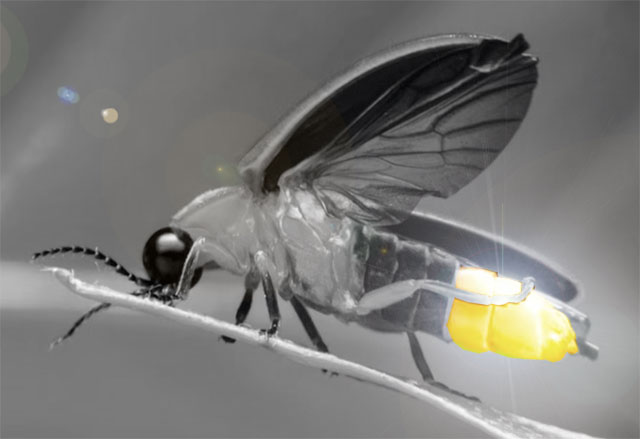
Even though bioluminescence is present in a wide variety of organisms — from fungi to insects to fish to algae — they all have one thing in common: a chemical system capable of producing light. In many organisms, this involves a compound called luciferin (any allusion to the Prince of Darkness is strictly intentional, I assume) and an enzyme called luciferase (there it is, again). Other organisms employ light-producing proteins can photoproteins. I won’t attempt to explain the chemical reactions that allow those enzymes to combine with luciferin, primarily because my college organic chemistry experience caused me to change my major from zoology to accounting, but also because this article does a much better job than I would. Plus, as we’ll see in a bit, I’m not alone in having a very incomplete understanding of the mechanics of this phenomenon.
I found it interesting to learn that bioluminescence does not occur naturally in plant life, but, thanks to our human propensity to try out new stuff for no apparent reason, scientists have managed to genetically engineer plants — tobacco plants, to be specific — to make them glow. [4] The linked article explains several approaches to making this happen, including those which proved temporarily successful but also killed the plants, something that Aleksandr Solzhenitsyn might have appreciated but never anticipated.
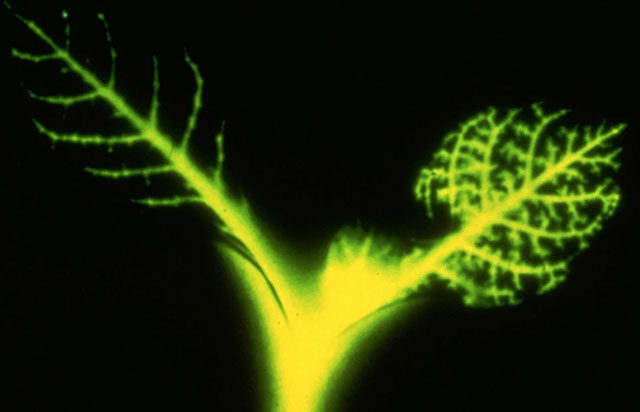
So, what purpose does bioluminescence serve in living organisms? Theories include defense, camouflage, communication, prey attraction, and attraction of mates. The deep-sea anglerfish is a great example of an apparent combination of those purposes.
Some deep-sea anglerfish live at depths exceeding 1,000 meters (3,280′ for us by-gosh normal people), beyond the point where solar light can penetrate — and get their name from the fleshy “lure” protruding from the top of their heads that in some species terminates in a glowing bulb called an esca; only the females have escas. The glow of this bulb is due to the presence of symbiotic bioluminescent bacteria, some belonging to the genus Photobacterium. [5] Thus, the deep-sea anglerfish itself isn’t technically bioluminescent; it employs bioluminescent bacteria to make it appear so. And as an example of the incredible perfection of creation, the bacteria produce predominantly blue light, which generally travels farther through seawater than red light. This makes it particularly useful for illumination in the deep-sea environment.
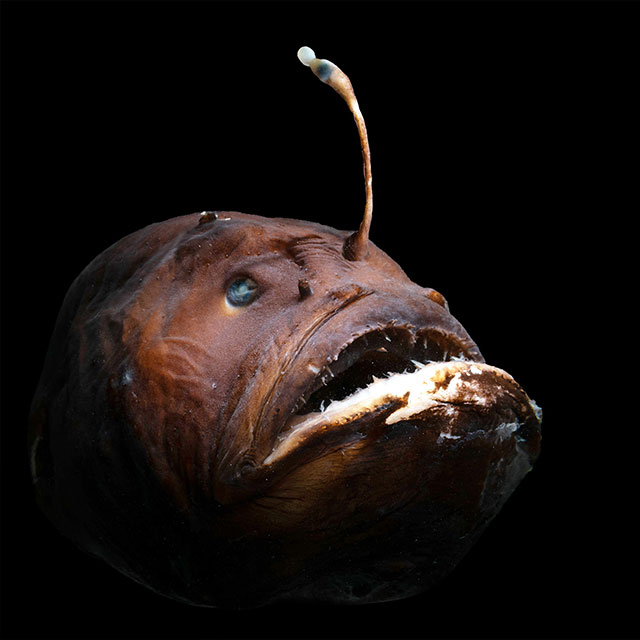
Now, despite the abundance of organisms that exhibit bioluminescence, and the highly focused studies of a handful of them, such as the deep-sea anglerfish, we really don’t know all that much about how the phenomenon works. As the authors of the paper cited earlier explain:
Despite being widely used in reporter technologies [6], bioluminescent systems are largely understudied. Of at least forty different bioluminescent systems thought to exist in nature, molecular components of only seven light-emitting reactions are known, and the full biochemical pathway leading to light emission is only understood for two of them.
A brief review of bioluminescent systems (2019)
Aubin Fleiss & Karen S Sarkisyan
Looking ahead…
Part 3 of this series will delve into a subset of bioluminescence, one that all living organisms share to some extent. But before that, we ought to learn more about biofluorescence, and that will be the subject of the upcoming Part 2. I hope I’ve piqued your curiosity enough to bring you back to the next installment.


Footnotes
[1] If you recognize this phrase as a lyric to a song, pat yourself on the back for your musical astuteness, if not your zoological savvy. If you know who sang it and you can at least hum the tune, don’t try to pat yourself on the back as you are too old for such shenanigans and you’re likely to injure yourself. If you know none of this, here’s where you go to get some important education, grasshopper. [Return]
[2] NED — Needlessly Esoteric Discussion. Sorry; that’s the best I could do. But, fortunately, ChatGPT could do better, so go with this: Nerdishly Esoteric Discussion. This is better than my suggestion, because ANY discussion that involves ultra-weak photon emission is going to be esoteric. And it just now occurs to me that this whole footnote has gotten out of hand. Out of foot? Whatever. [Return]
[3] I’m actually not going to spend much time discussing human auras because they’re a different type of phenomenon than the primary subject matter, and that’s if they even exist in the first place. I’ll instead direct you to this article, The Long History of the Human Aura, as it provides an objective account of the concept without going all woo-woo about it, IYKWIM. And even as I say that, I’m not trying to dismiss the centuries-old metaphysical traditions surrounding auras. From angelic halos to the visualization of Hindu and Buddhist chakras to modern techniques for detecting their presence, the concept is based on something, and far be it from me to assert that that something doesn’t exist. I mean, if a venomous, egg-laying mammal like the platypus exists, then anything is possible. [Return]
[4] If the idea of genetically engineered, glowing tobacco sends your mind into a labyrinth of possibilities, feel free to explore it at length. I would welcome your findings, because they would probably make me feel better about my own nerdishness. Here’s an article to get you started. [Return]
[5] You might be wondering how these bacteria end up inhabiting the deep-sea anglerfish’s esca, and if so, I’m impressed by your curiosity, and I owe you the answer. It’s pretty amazing, actually. As it turns out, anglerfish do not possess this bacteria at birth. Although the explanation is scientific conjecture, all indications are that female deep-sea anglerfish larvae somehow attract the bacteria, which then take up residence in the esca. In doing so, the bacteria get a steady supply of oxygen and some defense against predators, while the fish gets a perpetual lightbulb to use to attract prey, and more importantly, to attract a mate.
One of the more interesting aspects of the anglerfish’s esca is that the fish has the ability to dim or completely hide the glowing bulb when the light is either not needed or poses a danger by attracting predators. One of the ways it can do this is by manipulating tiny organelles called melanosomes, which are aggregated inside cells called melanophores (try to keep up!) to block the light emitted by the bioluminescent bacteria in the esca.
The melanophores that are present in some species of anglerfish are so effective in blocking reflected light that they represent some of the darkest, blackest substances in the known world (feel free to google “ultra-black” for more about that, or check out this brief discussion on Wikipedia).
Another, somewhat more draconian approach employed by the anglerfish is to choke down the oxygen it supplies to the bacteria, thereby reducing the bacterial metabolism which in turn dims the bioluminescence. And, finally, some species are able to physically hide the esca in a flap of skin.
Below is an excellent video that explores the anglerfish’s unique biology and lifestyle…including its mating and reproduction habits. If you think the praying mantis has a strange mating habit, wait until you learn about the anglerfish’s. It lends a new perspective to the phrase “mates for life.”
[Return]
[6] When I first saw the phrase reporter technologies in that paper, I couldn’t imagine why a reporter — even one versed in scientific pursuits — would be using bioluminescent systems as a part of their journalistic endeavors…and I have a pretty good imagination. Well, as it turns out, that phrase is totally misleading, unless you’re a bioluminescent researcher. OK, that came out wrong. I should have said, unless you’re a researcher delving into the mysteries of bioluminescence. (Although, if you stick with this series until the end, the first thing might prove to be more apt than you would guess. That’s called a “teaser.”)
In this case, reporter technologies are, according to Google’s Gemini [text is Gemini’s; links are mine], molecular tools—primarily reporter genes, proteins, or biochemical assays—used to track, visualize, and measure specific biological processes. They act as biosensors, translating hidden cellular activities (like gene activation or protein movement) into easily detectable signals such as light, fluorescence, or color changes.
I trust that this will completely answer any questions you may have about the phrase. If not…well…that’s the best I can do at this point. [Return]
Discover more from The Fire Ant Gazette
Subscribe to get the latest posts sent to your email.